
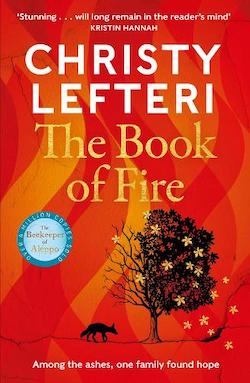
Published by Manilla Press, 2023, 341 pages.
“This morning, I met the man who started the fire. He did something terrible, but then, so did I. I left him.
“I left him, and now he may be dead. I can see him clearly, exactly as he was this morning, sitting beneath the ancient tree, his eyes as blue as a summer sky.”
Irini Diamandis lives with her husband Tasso and her daughter Chara in a Greek village. Tasso is an artist, and the family is closely knit.
Until one day a property developer—whom Irini dubs Mr. Monk because he lives by himself in a big house and sees almost no one—starts a fire to clear five acres of land that he has no claim on, so he can build a boutique hotel on it. The fire quickly gets out of control, and devastates the village, killing everything and everyone in its path.
Irini and Chara run to the water while Tassos goes back for his father. The three survive, but they are all shadows of themselves. Tassos’s hands are burned, so he can no longer paint, and sits in the garden for hours, barely engaging with his wife and daughter. Chara’s back is scarred by the fire.
One day, Irini goes for a walk in the woods and finds Mr. Monk sitting under the old chestnut tree—a tree that miraculously survived the fire, or at least half of it did. He is just about alive and clearly needs help. But all Irini can think of is that he was the one who “obliterated” her world, and she runs from him. Later, feeling guilty, she goes back to check on him and finds him dead.
Seeing him brings it all back, and Irini decides to write down everything that happened during and after the fire. The book moves between the present, where the family is struggling to come to terms with their drastically changed lives, and what Irini calls “The Book of Fire”, her account of the catastrophe. Woven into this narrative is the police investigation into Mr. Monk’s death—was it suicide or rough justice?
This is a beautifully written, harrowing book. Raging wildfires seem to have become a frequent occurrence in so many parts of the world that this feels topical. The way Christy Lefteri describes what happens during a fire and its aftermath feels very real—you can almost sense the heat and smell the smoke.
And the devastation it leaves behind is unimaginable: not just the property—people’s entire lives going up in smoke—but the loss of loved ones, of a way of life. And those who are left behind have to deal with their own scars, mental and physical. Whenever Irini goes into the village, she sees ghosts—the people who should have been there but are not. The half-burnt chestnut tree is a symbol of the wounded community: part of it completely devastated and the other still clinging on to life.
This is also a book about how climate change is affecting communities worldwide. Irini’s father-in-law Lazaros knows the woods surrounding the village well, and continually warns about how nature is changing, how the increasingly dry forest is becoming a tinderbox. But no one seems to be paying much attention to his warnings. He is proved right—the fire, although started by a man, had been a disaster waiting to happen.
The book raises questions about blame and guilt. In a case like this, the blame seems clear—it is one man’s greed that destroys so many lives, and the forest and the creatures that live there. But does that justify what happens to Mr. Monk?
This is a book that haunted me. I couldn’t stop thinking about wildfires and how it must be for people who live through them.
As I said earlier, the book is harrowing, but also beautiful. And in the end, it is nature and a wounded jackal that heals the family. I would highly recommend this book.
 Talking About Books