
Published by Charco Press, 2024, 265 pages.
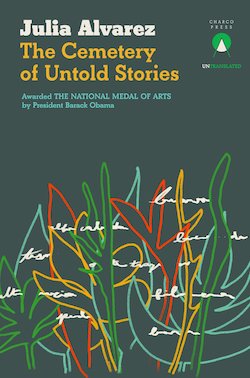
“As usual, she stops at El Barón’s tomb, to pay her respects, making the sign of the cross, then laying her fingers on the glass. The touch sets the flakes flying. A voice commences recounting its stories, other voices join in, more and more, as if blown by the wind or flying in on the wings of the twittering cigüitas who alight on one marker or other—a babel of noise, like the colmado on a holiday, packed with people drinking, gossiping, all talking at once.
“Filomena puts her ear to the glass and listens.”
An untold story can possess and destroy you. Alma is a successful author and professor, originally from the Dominican Republic, who moved to the US as a child. Alma’s friend, also an author, has a story she keeps meaning to write down but never does. She becomes obsessed with it right up to her death. Alma is convinced that her friend was killed by the untold story.
So when her parents die, leaving her and her three sisters various plots of land in Santo Domingo in the Dominican Republic, she picks the largest of the plots—one that her sisters do not want because it is next to a rubbish dump. Alma leaves the US and moves back to Santo Domingo with all the manuscripts of the stories she has never finished writing.
There Alma converts her plot of land into a cemetery for her untold stories. She burns each manuscript separately and buries the ashes. Except for two that she cannot bring herself to burn: the story about her father Manuel, a doctor; and that of Bienvenida, one of the wives of Rafael Trujillo, the dictator who ruled over the Dominican Republic from 1930 to 1961. These she buries next to each other. Manuel’s manuscript is the first to be buried, and as tradition dictates, the first grave in a cemetery is dedicated to El Barón, the boss of cemeteries who allows passage between the two worlds.
The cemetery becomes Alma’s home. Brava, an artist friend, makes sculptures for each of the graves, and Alma eventually builds a small house on the property. The gates are locked; to enter, people have to speak into a black box in response to a woman’s voice that says, “Tell me a story”. Only those with stories that pass muster are allowed to enter. One of these is Filomena, a woman living in the barrio of the cemetery, who becomes a regular visitor. Eventually, Alma hires her as a caretaker.
But buried stories do not stay buried. They want to be told, and as Filomena wanders in the cemetery, she hears the voices of the manuscripts telling her their tales. Especially the two buried ones: Bienvenida and Manuel. Filomena takes a chair to the graves, settles down and listens.
And, with Filomena, we also learn their stories. How Bienvenida was spotted by Trujillo on a visit to her village and how she married him against the wishes of her parents; how Manuel fled the Dominican Republic because he had fallen foul of Trujillo; and how his and Bienvenida’s paths crossed in New York in the hospital where he was working.
And we also learn about Filomena—how she left her village to look for her mother, who had left home; what happened between her and her sister, who had since moved to the US; and her love for her nephew. These were things that Filomena had kept to herself until she told them to the black box in the cemetery of untold stories.
What happens to stories? Are stories untold because they aren’t written down, asks Brava. If they are not written down and the teller dies, says Alma, then the stories die too. Brava disagrees: the stories are passed on, she says. “Brava lists her favorites, stories coated with Mami’s milk, punctuated by Abuelita’s cachimbo coughs, known, remembered, beloved on a cellular level, long before Alma wrote them down.”
This is a beautifully written book. Julia Alvarez brings the characters to life: not just the principal ones, but also the people in the barrio and Alma’s sisters (I thoroughly enjoyed the conversations they had, with the sisters voicing strong opinions on what Alma should or should not be doing).
What comes through is a carnival of voices as people—alive or dead or imagined—insist on telling their stories, reimagining and rewriting their lives.
This is a book about the power of stories: the ones we tell and the ones we keep buried, and how sometimes they can become distorted in the telling. It is, in a way, an acknowledgement of all the stories that we carry within us, stories that often remain untold.
 Talking About Books
I read this recently and was really impressed by the way it made the metaphorical literal – always a tricky thing to do but here both subtle and credible.
Yes, it’s so well written.
Pingback: The Best Books of 2024 – Talking About Books
Pingback: Best Books of 2025 – Talking About Books