
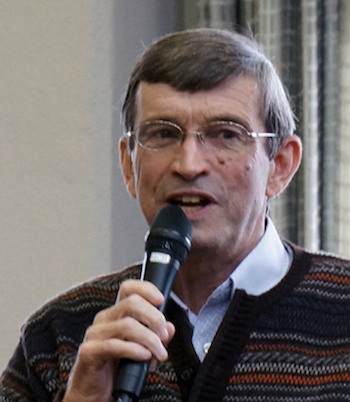
Robert W. Norris is an American writer and retired teacher who lives near Fukuoka, Japan.
Robert’s books include his memoir, The Good Lord Willing and the Creek Don’t Rise (2023); novels, including Looking for the Summer (1996); The Many Roads to Japan: A Search for Identity (1997); Toraware (1998); and Autumn Shadows in August (2006). He has also written several articles on teaching English as a foreign language.
Talking About Books interviewed Robert on his experience as a conscientious objector, his mother—to whom his memoir is dedicated—and how language affects the way we interact with the world.
TAB: You joined the US Air Force during the Vietnam War but then became a conscientious objector. What made you change? What impact did your experience as a conscientious objector have on your life?
RWN: All young American men of my generation still faced the draft when I graduated from high school in 1969. If drafted, the odds were quite high of being sent to the front lines of the Vietnam War. For those of us who thought the war was wrong but lacked a strong enough religious background to qualify as a conscientious objector, one alternative to the draft was to join either the Air Force or the Navy. I visited an Air Force recruiter, who promised that I’d never have to carry a weapon. I naively believed him and joined the Air Force.
As it turned out, I had to go through combat training and was made a security guard for B-52 bombers. While walking around those gigantic death machines every night at the California air base I was sent to, I began thinking about the war very seriously. I had many influences and went through radical changes. I talked to many soldiers who had returned from the war and become anti-war activists. During this time, there was a growing movement against the war from within the military. For anyone interested in this part of American history, I would highly recommend reading David Cortright’s Soldiers in Revolt: GI Resistance to the Vietnam War.
I became involved with some anti-war soldiers who were secretly publishing an underground newspaper. In free hours, we often met to discuss the war, philosophy, the My Lai Massacre, popular songs with anti-war lyrics, literature such as Dalton Trumbo’s Johnny Got His Gun and Erich Maria Remarque’s All Quiet on the Western Front, the demonstrations that were proliferating around the country, and what we should do if we received an order to go fight in the war. The deciding factor for me to apply for conscientious objector status happened on 4 May 1970, when four students were shot dead by the National Guard during a protest at Kent State University. I felt I could no longer in any way participate in what to many of us was an unjust and immoral war in which the military was now being used on its own citizens. My order to fight came not long after. I refused the order.
My military lawyer, an anti-war man himself who worked very hard on my case, and I were encouraged by a precedent-setting Supreme Court ruling in June 1970—Welsh v. United States, 398 U.S. 333 (1970)—that recognized not only religious grounds but also moral and philosophical grounds for conscientious objector status. Unfortunately, my application was turned down by the Air Force, but I was able to claim a kind of moral victory at my court martial when I was found innocent of the charge against me, which was “wilful disobedience” to a direct, lawful order. It carried a maximum penalty of five years in prison and a dishonourable discharge. Instead, I was found guilty of the lesser military crime of “negligent disobedience.” I was sentenced to six months in prison. The difference in the verdict and length of sentencing was in how I’d responded to my order. I never used the word “no.” I merely repeated the same sentence several times: “I don’t feel I’m mentally or physically capable of killing another human being.”
That single sentence saved four and a half years of my life. As for the impact the experience had on my life, it was the start of a lifelong interest in the importance and power of language. In later years after a couple of journeys abroad, the desire to live, work, and study in a foreign country grew within me. That dream eventually came true in Japan.
TAB: In 1983, you moved to Japan, where you have been living ever since. In spite of the fact that Japan is so different from the US, in terms of both culture and language, you have integrated into Japanese society. What are the biggest differences between Japanese and US cultures, the ones that affected you personally? And what are the things in common?
RWN: I’ve lived in Japan for so long now that I hardly notice cultural differences and similarities anymore. Everything seems more or less normal to me. On the other hand, if I returned to live in the States, I’d probably experience a kind of “reverse culture shock” and have trouble in readjusting.
In my first few years here, however, there were some striking differences that took some time for me to become accustomed to. One of those was the way Japanese listen and respond to what a speaker is saying. In the West, people often show their interest in the speaker by nodding or responding to the speaker’s full explanation, opinion, criticism, etc. Japanese use what are called aizuchi—responses of brief words or sounds to show interest and empathy—but they often use them two or three times for each sentence the speaker utters. To a native speaker of English, this can seem quite rude. Before I finally got used to the different timing for aizuchi, I would often think, “Would you please keep quiet until I’m finished speaking?” Ironically, when I became more proficient in my own usage of aizuchi, I often gave the impression that I understood more than what I actually did.
Another thing that took a long time to get used to, especially while I was teaching at a university and had fairly heavy responsibilities in several committees, was the Japanese penchant for meetings. Of course, in other countries most groups, schools, and companies have regularly scheduled meetings, but in Japan there are different layers of meetings. First, there are “pre-meetings” called uchi-awase where the agenda items for the main meeting are scripted and laid out. Next is the main meeting where explanations are made, questions are answered, roles for different projects are assigned, and upcoming events are outlined. Minutes are usually recorded. Quite often, particularly when the main meeting was about some event to be carried out, another “post-meeting” called hansei-kai is scheduled after the event to elicit opinions about the event’s successes and failures, suggestions for improving the planning and carrying out of the next event, and to assign responsibilities for investigating details of any further plans to be made or information to investigate. I managed to survive my participation in these endless meetings by taking the attitude that they provided a good way to improve my Japanese. I always had an electronic dictionary with me and a notebook in which to write new vocabulary and sample sentences.
As for things in common, people in Japan—and, for that matter, everywhere I’ve journeyed in this life—laugh and cry at the same things; ooh and aww over babies; enjoy preparing and eating good food; and appreciate favourite music, sports, art, literature, and movies. They are sensitive to other people’s pains, woes, frustrations, and joys. They long for peace and good will.
I can honestly say that I’ve been blessed to make many close friends and enjoy a fulfilling life during my 40 plus years in Japan. I plan to stay here till my final day on this earth.
TAB: Your memoir, The Good Lord Willing and the Creek Don’t Rise, is dedicated to your mother. From what you write about her, she seems a woman ahead of her time. Could you tell us more about her?
RWN: My mother had more of an influence on me than any other person in my life. She was a strong, independent, and optimistic woman who always encouraged and supported me. She was an artistic and adventurous soul who always saw the good in people. She was a great storyteller and no one could make me laugh as hard as she could. Simply put, she was my best friend. When she passed away, I wanted to preserve her spirit and show other people what a wonderful person she was. That’s the main reason I wrote the book.
In my childhood, Mom often told stories about a large cast of relatives who banded together during the Depression, loaded their belongings into two jalopy trucks, and made the trek from North Dakota to Oregon and Washington, settling on the banks of the Columbia River, where she grew up.
Later in life, she had to overcome a logging community’s ostracism when she divorced in the late 1950s, excommunication by the Catholic Church when she remarried, severe criticism and rejection for defending my refusal to fight in the Vietnam War, and the burden of paying off her second husband’s gambling debts before another divorce. She became a licensed pilot and flew two summers for the Department of Forestry as a spotter for forest fires. I think she was more proud of that than of any other accomplishment in her life. During her initial training, a couple of men told her to give it up because she was a woman and “women don’t do those things”. Mom bet one of them that she’d score higher than he would on the final test. She won that bet and never let him forget it.
In her 50s, she took night classes to become qualified as a legal secretary. That was the key to her independence. She ended up working until she was 78. She travelled to Japan eight times and once to Ireland with me in fulfilment of her lifelong dream to find her father’s family roots. She passed away in January 2021, four days short of her 95th birthday.
TAB: Your books often centre around a search for identity—including your memoir, which traces your journey as well as your mother’s. Why is this theme so crucial for you?
RWN: I think a search for identity is one of the most pervasive themes in American literature. The questions of who am I, where do I belong, what is the meaning of my life, and what is my destiny are at the root of every human’s life journey. In terms of an American viewpoint, they form the core of many well-known American literary characters from Melville’s Ishmael, Twain’s Huckleberry Finn, and Salinger’s Holden Caulfield, to Jack London and Jack Kerouac’s autobiographical protagonists.
Authors from other countries who pursued similar themes have also influenced my writing. In my 20s when I was first beginning to write, Hermann Hesse’s novels resonated strongly with me, especially the main character’s search for identity in Siddhartha, Beneath the Wheel, and Demian. Somerset Maugham’s Of Human Bondage and The Razor’s Edge also moved me deeply.
Both my mother’s life and my own were often battles of resistance against forces we believed bound us too tightly. In a sense, we both seemed to have inherited her grandfather’s genes. He had the wanderlust and a strong curiosity about the world. He came from a family of immigrants who settled in Pennsylvania. In his youth, he became a hobo who rode the railroads in search of farm labour work. After he married and had a family, he led his family across the US during the Depression until they settled near the West Coast. I think Mom and I inherited his sense of wonder about the outside world, his strong sense of self-reliance, and his resistance to authority when it put too much constraint on his sensitivities. We both had a strong desire to express ourselves in some artistic form. We had itchy feet that often drove us to seek new environments and ways of thinking and living. We both travelled many paths during our separate but connected lives. All in all, a search for identity—spiritual, emotional, or otherwise—defined our lives. As a matter of course, it became a dominant theme of almost everything I have written.
TAB: Several of your novels seem to draw on your own life—for example, Looking for the Summer and The Many Roads to Japan. Did writing these books eventually help you write your memoir?
RWN: Yes, most certainly. In a sense, all the earlier autobiographical fiction that I wrote prepared me for the writing of The Good Lord Willing and the Creek Don’t Rise. I selected various sections of my novels, reworked them into a first-person narrative form, and wove them into appropriate parts of this latest book.
Mom and I also had a lifelong correspondence—through both regular mail and email—much of which I had kept through the decades and my various journeys. In addition, I had recorded several of her family stories and transcribed them. I was able to put all that material to good use, too.
TAB: As someone who is fluent in two very different languages, do you believe language affects the way we interact with the world?
RWN: That’s kind of you to say I’m fluent in Japanese, but I think I still have a long way to go before ever reaching that level. Yes, I do believe language affects the way we interact with the world. When visiting with other native speakers of English, I tend to be more open in stating my true opinions about serious topics. I have long arms and often use them in fairly animated gestures. I like to think I take an egalitarian approach in the language I use with others, regardless of their age or social status. My sense of humour has a stronger sense of fatalism.
In Japanese, my gestures are more restrained, especially in public. I try to be more considerate of what my relationship is with the other person and what the difference is, if any, in our ages or status. I try to “read the air” (direct translation of the Japanese expression) and use the appropriate level of formality or informality that is called for culturally. In a word, I’m more conservative in Japanese. Of course, when I’m with close Japanese friends, I feel more at ease and my communication style becomes more natural.
TAB: When did you start writing? Is it something you have always done?
RWN: In 1973 at the age of 22, I hitchhiked across the States and bummed around Europe for a few months. I was a confused young man with no direction in life. Everywhere I went, I came into contact with young artists, poets, and musicians whose lives seemed filled with something important and meaningful. They all spoke more than one language. They motivated me to find some way to express myself and maybe someday study another language. When I returned to the States, I began writing short stories and studying as much literature as I could. What started out as a kind of therapy eventually became a way of life.
TAB: Thank you, Robert, for sharing your experiences and your journey with us.
Read my review of The Good Lord Willing and the Creek Don’t Rise.
 Talking About Books