
Published by HarperOne / Coronet, 2022, 293 pages.
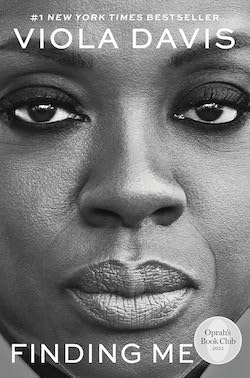
“Everybody has secrets. Everybody. I guess the difference is that we either die with them and let them eat us up, or we put them out there, wrestle with them (or they wrestle with us) until we . . . reconcile. Secrets are what swallow us.”
In this blistering memoir, Viola Davis—one of the most talented actresses on screen today—reveals the struggles of her childhood and what it took for her to get where she is now. Her past is full of memories she has tried to forget for most of her life, but she finally understands that you can suppress trauma for only so long before it resurfaces.
Davis was the fourth of five children, a boy and four girls. Her father Dan worked as a groom in a stable and her mother Mae Alice ran the house in Central Falls, Rhode Island, the most densely populated town in the US. Davis grew up with bullying in school and violence at home. Not only was her father brutally violent towards her mother, but they had almost no money and lived in an apartment in a condemned building without hot water or heating, and in winter, the pipes would freeze, leaving them with no water. Soap was a luxury, so they used whatever was handy—dishwasher soap, laundry soap… What they did have in abundance, however, were rats.
She writes, “We were ‘po.’ That’s a level lower than poor. I’ve heard some of my friends say, ‘We were poor, too, but I just didn’t know it until I got older.’ We were poor and we knew it. There was absolutely no disputing it.”
Fortunately, Davis’s mother and sister taught her to fight, to stand up for herself, and most important, to study and work hard. Her sister Dianne would come home from school and teach her younger siblings what she had learned. Dianne also inculcated the work ethic in Davis: she told her that if she did not want to live like her mother, she needed to have a clear idea of what she wanted to be, and work hard to get it.
And that is exactly what she did. Davis got into Julliard, which turned out to be not entirely what she had expected. It was geared to “a European approach to the work, speech, voice, movement.” The aim was to create a perfect white actor. There were only 30 Black students in a total of 856. Ethnic material, jazz, gospel, and other similar art forms were forbidden. What Julliard did give Davis was a scholarship to a summer programme that was meant to help artists develop and grow. The person running the programme took the group to The Gambia, and her time in Africa was a revelation for Davis, a sense of liberation, of being able to be herself.
Returning to the US and trying to break through in acting was not easy for a dark-skinned woman—she often played drug-addicts or the lead’s best friend. She had bad relationships with men who did not love her. Finally, things began to turn around and brought her to this point: happily married and a success in her work.
On the back cover of the book, Davis writes: “My hope is that my story will inspire you to…rediscover who you were before the world put a label on you.”
This is a harrowing book but also one of healing and strength. Her writing feels immediate, like she is telling you her story. You can almost hear her voice. And she spares no details, does not gloss over anything. Her candour in telling her story makes this a powerful book.
It took a long time for Davis to feel that she was valued and for her to come to terms with her past and make peace with her father. But she got there in the end, and it is an inspiring journey.
 Talking About Books
Pingback: The Best Books of 2024 – Talking About Books