
Published by Tin Gate, 2023, 469 pages.
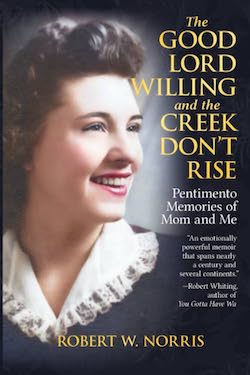
Sometimes so-called ordinary people lead extraordinary lives. The two people at the centre of this memoir are among these: Robert W. Norris and his mother, Kay Murphy Schlinkman. Norris writes about his life, weaving it with his mother’s, someone who influenced him deeply and with whom he formed a strong bond.
A remarkable woman, Murphy Schlinkman was a Catholic who divorced in the late 1950s, then remarried and divorced again. She was ostracized by her community, and after her remarriage, was refused communion. To make ends meet after her second divorce and to pay off the gambling debts left behind by her second husband, she worked as a legal secretary, a present-wrapper at a mall, and a night clerk and cleaner at a hotel. Because she did not have the money for gas, she used to cycle to work, even when it snowed. She took flying classes and obtained a pilot’s licence—the only woman in her class, egged on by the fact that the instructor did not think she had it in her. And she also had a wicked sense of humour.
Norris grew up in California. When he was drafted during the Vietnam war, he opted for the Air Force because he did not want to have to carry a gun. He underwent gruelling training at the air base, where he contracted pyorrhoea of the gums. That ruled him out for the special training programme. Instead, he was assigned as a military policeman.
By the time his orders to fight in Vietnam finally came through, he was beginning to have serious doubts about the war. He had been reading underground newspapers reporting on what was really happening. Norris refused to go to Vietnam and became a conscientious objector. He was court-martialled and thrown into prison. Many of his family turned against him, telling him that what he was doing was shameful. Through it all, his mother was his biggest supporter.
Once Norris got out of prison, he worked and saved enough to travel through Europe and Asia in the late 1970s. He went to Afghanistan by bus, staying with an Afghan family there. When he returned to the US, he lived in Seattle for a while, and then drove across the country, working at various jobs. He also began writing.
The next big chapter in his life was his move to Japan. He got a job teaching at an English conversation school and eventually moved to the Fukuoka International University, where he taught for several years and was dean of students until his retirement. He is fluent in Japanese, is married to a Japanese woman and has made his home there.
This book is Norris’s autobiography, but it is also a tribute to his mother, who was a constant presence throughout his wanderings.
Norris writes in great detail, especially about his time in Japan, which forms the second half of his book. He has an interesting story to tell, and I was particularly intrigued by how someone moves to a new country with a completely different culture and language, and makes a success of it.
His time as a conscientious objector was also enlightening. I had not read a first-hand account of what it was like, especially for someone who had joined the military. His account of the grilling he went through felt very real.
Through this book, you follow Norris from his time as a rebellious adolescent to a man who can look back at a hard-won and successful career. It is also a glimpse into how the US has changed over the decades and what it is like to live in Japan as a foreigner. However, it would have been helpful to have had a few more dates as he recounts his story.
Norris’s mother comes across as incredibly positive and resilient, given all she had to go through. However, the rejections she faced over the years led to depressions, but somehow, she still found the strength to keep going.
Norris has a way of bringing the period he is writing about to life, whether it is his grandfather Frederick in the 1880s, or his time in Japan. He also writes movingly about what it is like to grow old, and come to terms with illness and death.
His writing can be lyrical, such as this description of his childhood in Jacoby Creek: “This joyful world of mine is also in the November smoke that emanates from the fireplaces of Jacoby Creek, in the smell of freshly mown lawns, and in the April bees buzzing from flower to flower to gather their pollen. … It’s in the darkness that prowls softly through the silence of the forest at night. It’s in the earthy fragrance of the trees, the grass, and the flowers that surround me…”
This book is a very personal portrait of a mother and son, and their strong bond; and a look at what life was like, especially in the US, from the early 1900s to now. His mother’s story, especially, shows how far we have come.
 Talking About Books
Pingback: A Life’s Journey: An Interview with Robert W. Norris – Talking About Books