
Translated from French by Sara Hanaburgh
Published by University of Virginia Press, 2014, 223 pages. Original version published in 1989.
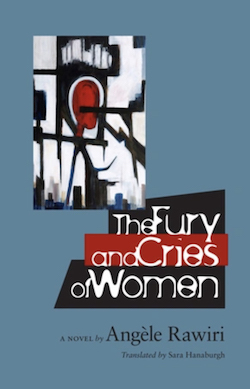
This book by Angèle Rawiri, considered the first novelist from Gabon, is about the position of women in a society that has modernized without ridding itself of traditional roles. Emilienne, a woman in a fictional African country called Kampana, is caught in the tussle between modernity and tradition.
Emilienne’s husband Joseph is from another ethnic group, and they married against the wishes of her parents and Joseph’s mother. Her parents have come around to the marriage but her mother-in-law Eyang resents her (and lives with them, which makes it worse).
Life is not easy for Emilienne. Her marriage is not going smoothly. As managing director in a government entity, Emilienne earns much more than Joseph, a civil servant, and the large house they live in—with their daughter Rékia, Eyang and Joseph’s two nephews—has been given to her because of her work. All this makes him feel inferior, and he has taken a mistress.
Emilienne feels that if only she could give Joseph another child, she could win him back. But every pregnancy ends in a miscarriage. Eyang, in the meantime, is plotting to get rid of Emilienne and substituting her with Joseph’s mistress.
Then tragedy strikes, and Emilienne is just about holding on. Lonely and neglected, she starts an affair with her secretary, Dominique. But Dominique wants her to leave Joseph and live with her, but Emilienne does not want to and, anyway, society would not accept the two women living as a couple.
Emilienne is part of both worlds, the modern and the traditional. She sees a woman’s womb as the source of her real power: giving birth is the one thing men cannot do. But her desire for a child seems to stem more from her wanting to hold on to her husband rather than her own need.
But she is also a rebel, a woman who refuses to play the role that society expects of her, a woman who questions assumptions that are taken for granted. She resents the importance society places on motherhood, seeing a woman as primarily a wife and a mother, with her professional life taking second place. She confronts her sister and her parents, who are trying to encourage her to have more children. “It seems that, even today, a woman can earn her entire family’s respect and consideration only if she is a mother. … In indigent families, those unplanned children aren’t properly nourished or cared for, and then we’re surprised to see a rise in the infant mortality rate or a rise in the number of juvenile deaths.”
Some of Emilienne’s and Joseph’s internal monologues feel a bit expository, especially as Emilienne tries to understand her state of mind and how her marriage had got to this point. You follow her as she goes through despair, depression and anger. She loves Joseph, and her marriage is central to her happiness. She is proud of her job and tries to make a difference, but is subjected to intimidation by some of her colleagues, one of whom tells her to “file your good intentions away in one of your desk drawers”.
Rawiri raises some thorny issues: infertility and the importance society places on motherhood, lesbianism in a conservative society, and the way healing—both modern medicine, and traditional or alternative healing—can fail women. These are issues, according to Cheryl Toman in her afterword to the book, that had not been touched on by African authors, especially women authors.
Rawiri used a fictional country, not because she wanted to disguise Gabon but because she wanted the story to go beyond the mere boundaries of a country.
This is a comment on how women cannot be allowed to have it all, and how traditional stereotypes and pressures still try to limit them. It is, in some ways, a universal story.
 Talking About Books
Pingback: The Best Books of 2024 – Talking About Books