
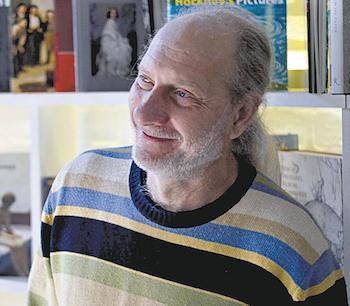
(Note: This interview was originally conducted in Spanish and translated by Leslie Jones.
Lea aquí la versión en español.)
Luis Sagasti is an Argentinian writer, lecturer and art critic.
Luis’s books include Lenguas Vivas (2023), which was longlisted for the Premio FILBA-Medifé for best novel 2024; Leyden, Ltd. (2019); Por qué escuchamos a Led Zeppelin (2019); Una Ofrenda Musical (2017, translated into English as A Musical Offering, 2020), which won the Segundo Premio Nacional de Literatura in 2023; Bellas Artes (2011, translated into English as Fireflies, 2017); and El canon de Leipzig (1999).
Luis worked as a curator at the Museo de Arte Contemporáneo de Bahía Blanca in Argentina for eight years.
Talking About Books interviewed Luis on how he gets the ideas for his books, on the role that war and art play in his writing, and on the importance of languages.
TAB: I love the way you put your books together: the disparate elements that you weave into a whole with recurring themes. How do you build your books? Do you start with the theme and then find the elements, or are there elements that catch your eye and give you the idea for a theme?
LS: I really don’t have a methodology or a sort of algorithm to start writing a novel. Or at least it is not something I notice. Usually the trigger is a story, a scene, often from real life, like the Brazilian priest who got lost in heaven in Fireflies. I think that from that point the text begins to come together. Some loose information, something that catches my attention can also function as a trigger once the story has already begun. I have a natural disposition to associate things, facts, and at the same time to scatter. But it is not a meaningless drift. Let’s say I go sailing with the intention of being able to return to port.
TAB: The way you write reminds me of the way we learn to see constellations: creating stories from stars that are otherwise unrelated. You can see them simply as disparate stars, or as points of light that can be joined to tell a story. For example, in Lenguas Vivas, you pull together photographs, languages and lighthouses. How do you find the connections among diverse elements?
LS: Well, what an interesting observation. I usually think of constellations when I put together my books. I also think of them as records—even though they are no longer heard—when it comes to the structural editing, that is, which text or chapter goes where (except the first and last, which are very clear). The connections are there. There is not a will to seek them out, they simply appear. The danger is that many times there are connections or certain coincidences, so to speak, that can be very attractive but that either do not lead anywhere or fail to integrate organically into the story. I must admit that I have a good memory for useless information, for example, the approximate number of lighthouses in operation. When I read that the number of languages is almost the same, the connection occurs by itself.
TAB: Your books are like the literary version of a piece of music, both in terms of structure, with recurring themes and counterpoints, but also in the way you use language. When you write, do you think about the way it is going to sound?
LS: In some ways I think so. The musicality of my texts is a topic that matters a lot to me. Not only in a purely plastic sense, I am referring to the formal concern for the construction of a phrase, its internal music (and also, avoiding the extension of certain metrics, certain “melodies”) but also the musicality of the book as a whole. That’s why I’m interested, as I said, in the order of the chapters, the resonance between them, the dialogue that can be established among them. The problem is that the result is a hybrid that moves between story, novel, essay and poetry. Bah, there is no such problem except when defining what one does.
TAB: In Leyden, Ltd., you construct a book entirely out of footnotes. This is an unusual way of telling a story. How did this idea come to you?
LS: It’s an idea I’ve had for a long time. I couldn’t find the topic, the story to record. Then, when taking notes for the book Why We Listen to Led Zeppelin, I found my eureka. A hidden artist/activist who makes his performances and interventions. It is a book that I like a lot. I wallpapered my entire desk, which gave the impression of a film montage. As a footnote to this question, I must say that I hardly ever read a footnote in a text.

TAB: War plays a large part in Fireflies, A Musical Offering and Lenguas Vivas. Why do you keep returning to the theme of war?
LS: My experience with war is having been a soldier at the time of the Malvinas conflict. I was lucky not to go into combat. However, I don’t think that’s where my interest comes from. I think I’m interested in the mental state of people who find themselves in that situation. It is the return to pure animality, the reduction of our expectations to the immediate present, the return of man to the caves. As if our entire system really hangs by a thread and we have never strayed far from the sabre-toothed tiger. The other thing that interests me about the subject is how the war discourse convinces people so easily.
TAB: You use painting, music and photography to thread themes together. Why does art play such a central role in your books?
LS: I just love art in almost all its forms. As a child, my father taught me how to draw (he really drew very well) and together we used to look at booklets about great painters. In fact, sometimes, when I correct and try to fine-tune a book, I feel as if I am painting. An impressionistic thing, where the eye wanders across the entire canvas without anchoring in any place, where the brushstrokes connect one shape with another. I’m interested in doing the same with the ideas and stories that appear in a book.
TAB: You write about silences and empty spaces: for example, the space between words or on a page of written text, the space between two objects in a painting (God and Adam in the Sistine Chapel, two bison in the Lascaux caves), and the silences in music. What do these empty spaces signify?
LS: Unlike nothingness or absence, emptiness is the space that allows, that facilitates, the possibility of growth. That what is in a state of germination may manifest itself. That is why it is so important to generate them. The example is sport: strategy must be used to create the space where to take the game. What I want to generate in my texts—with varying success—is a void that allows the reader to trace their own constellations. Not to say everything, never be very clear (in truth the latter is almost always inevitable: one writes with the awareness that language has its limitations). But it is definitely the emptiness that makes art work, right? Like the bowl is the essence of a glass.
TAB: You also write about a different kind of silence, the silence that comes from losing a language. Even though the language might have been preserved in written form, how much do we lose when its last speaker dies?
LS: I think I am not being melodramatic if I say what has already been said on other occasions: a cosmos is lost, a singular relationship between man and reality, a way of organizing it, of giving it meaning, of singularizing it. A poetic dimension is lost. Finally, the languages that survive are the most effective when it comes to solving certain issues. But life is worth living for that which shies away from efficiency, from the protocols imposed simply by how useful the ends are.
TAB: When did you start writing? Is it something you have always done?
LS: When I was seven years old, a schoolmate showed us his comics. I was stunned. Not because they were great, by any means, but because I simply realized that I could do that too. So I started writing my own comics. A mix of Tintin with Jules Verne and whatever movie I was watching. I was always a big reader. I would say that the serious impulse to write something came to me when I was 17 or so. I loved Henry Miller and wanted to write like him. The problem is that at that age… one has not experienced anything at all to be able to do it! I began to write what would become my first novel to be published (1999), because the idea came to me suddenly like a bolt of lightning (and I still like it a lot today) in 1990. 35 years ago.
TAB: Thank you for sharing your insights and for the journeys you have taken us on.
Read my reviews of A Musical Offering and Fireflies.
 Talking About Books
Pingback: The Best Books of 2024 – Talking About Books
Pingback: A Musical Offering: Luis Sagasti – Talking About Books
Pingback: Fireflies: Luis Sagasti – Talking About Books