
Published by Pushkin Press, 2012, 322 pages.
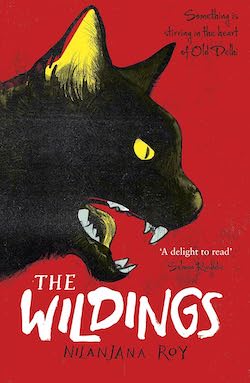
The stray cats of Nizamuddin are on edge. They sense a new cat in their neighbourhood. This is no ordinary feline: this is a Sender.
The cats of Nizamuddin, an old neighbourhood of Delhi, can communicate with each other over long distances, not just by mews but by scents and whisker transmissions. However, a Sender, whose “fur seemed to brush by the listener, its words and scents touching the listener’s whiskers, was rare”. A Sender can communicate—link—with other species, not just cats.
Convinced that this intruder was a powerful cat who would destroy them, the stray cats agree to find it and kill it. All they know about the newcomer is that her name is Mara, and she is a domestic cat. Beraal—“the most fierce of the queens of Nizamuddin”—is sent to carry out the deed.
But when she gets to the house, Beraal finds that Mara is only a kitten, a kitten who does not understand her powers and has no idea that she is connecting with, and upsetting, the Nizamuddin cats. Beraal takes her under her wing and trains her to use her powers. The other cats want her to kill the kitten, but Beraal is determined to protect her. Besides, a Sender only appears when there is a need, and it was possible that Mara’s powers could be useful to the clan someday.
Meanwhile, Southpaw, a kitten in the Nizamuddin clan, and one who seems to be a magnet for trouble, ventures too far into the old Shuttered House, a place that the stray cats know to avoid. It is a house full of feral cats and the human—the Bigfoot—who owns the house is dying. The feral cats have lived inside the house all their lives and been fed. They have no morals, no sense of right and wrong, just endless cruelty and a disregard for life. Southpaw is lucky to escape alive.
But one day, the cats in the Shuttered House begin to stir. Their Bigfoot has died. They no longer have a home and they have just discovered the outdoors, with all the creatures that live there, creatures they can kill, not for food but simply for pleasure, something the stray cats would never do. If they are not stopped, it would be a matter of time before they leave the house’s boundaries. And then no one will be safe anymore.
Will the Nizamuddin cats be able to fight their new enemy, an enemy that knows no rules or boundaries? Will they be able to persuade the other species—the squirrels, the cheels,[1] and the rest living in Nizamuddin, to join the fight? And will Mara be able to use her powers to help win this war?
This is a powerful story, with violence and bloodshed. Nilanjana Roy may be writing about cats, but they are not cute, cuddly things: these cats are predators, fighters and survivors. Each of the Nizamuddin cats is beautifully drawn—Miao, the wise Siamese; Katar, Southpaw’s mentor, and Hulo, the warrior. The animals all have names, while the humans are referred to as Bigfeet and remain in the background, something I loved.
Roy brings this world to life. I have to say I found the feral cats terrifying. She also writes about what it means to be an outsider—Mara as an outsider in the world beyond her house, and the cats living on the edge of a human world—and what it takes for them to survive.
I recommend this book—I could not put it down. It seems to be out of print, but is available second-hand, and on Kindle. There is a sequel, The Hundred Names of Darkness, which seems easier to find.
[1] Birds of prey.
 Talking About Books