
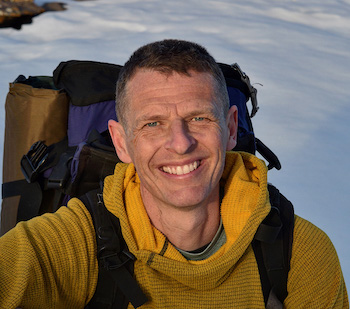
Andrew Terrill is a writer and photographer from London, England, who now lives in Colorado at the foot of the Rocky Mountains.
His books The Earth Beneath My Feet (2021) and On Sacred Ground (2022) describe a solo 7,000-mile walk from Italy to Norway. This walk raised funds and awareness for homeless people in the UK.
For most of his adult life, Andrew has made spending time in nature a priority. He camps in the wilderness at least one night every week, maintains a daily “nature habit”, and regularly blogs about his outdoor experiences.
Talking About Books interviewed Andrew about his 7,000-mile walk and how it changed him.
TAB: In 1993, you had a close brush with death when you fell off a mountain. Can you tell us more about this experience?
AT: I certainly can, although the accident wasn’t my finest hour! It happened because I made some highly questionable choices, and the experience itself was profoundly unpleasant. But, ultimately, I benefited immensely. It was a wake-up call that changed my life.
I was 23 when it took place. I was young, anxious, and felt trapped within the life I was then living. Basically, I’d been brought up in the suburbs of London to see the world in a particular way and to live in a particular way, but that way felt wrong to me. I had a job, but it didn’t fulfill me. I had somewhere to live, but I felt hemmed in. And I had a bad stutter, which meant that even in a city of millions I was socially isolated. Supposedly, my suburban life gave me everything I needed, but I craved an existence less predictable and far more challenging. Above all I craved mountains and nature—which London clearly doesn’t offer in great abundance!
The mountains were the only places where I truly felt alive. I escaped to them whenever I could. On this occasion I’d travelled to the Swiss Alps to walk for a week over several high passes, the highest one still buried beneath snow. Experience told me my route would be difficult, but that was what I wanted—an adventure. It just turned out to be more adventurous than I’d bargained on!
The fall began when I was descending steep snow from the highest pass. I heard falling stones, looked up to see if they were heading my way, but did it too quickly, lost balance, and began tumbling. There really isn’t space here to describe the fall in detail, but to put it simply: it became like another existence. Time stopped. I bounced and spun and cart-wheeled down the mountain. I felt as though I were falling for eternity. Possibly, I should have been knocked unconscious each time I struck the mountain. Possibly, I should have continued down the slope then spun into the void that waited beneath. Fortunately, neither of these undesirable outcomes occurred! Instead, after falling 1,000 feet, I managed to bring myself to a halt… although not without shredding my fingers in the process as I clawed at snow and ice.
I learnt a great deal from the accident—again, too much to go into here. But most importantly I saw for the first time in my young life that life itself was incredibly fragile and unfathomably precious. I saw that it could end at any moment, and that it was a gift not to be taken for granted (as I’d been doing), or wasted (also as I’d been doing). I saw that I’d been given a second chance. And I saw that I wasn’t really trapped in London as I’d supposed. I did have a choice.
As I said: the fall was a wake-up call. It shook me to take charge of my life.
(I describe the experience in more detail in the prologue of The Earth Beneath My Feet.)
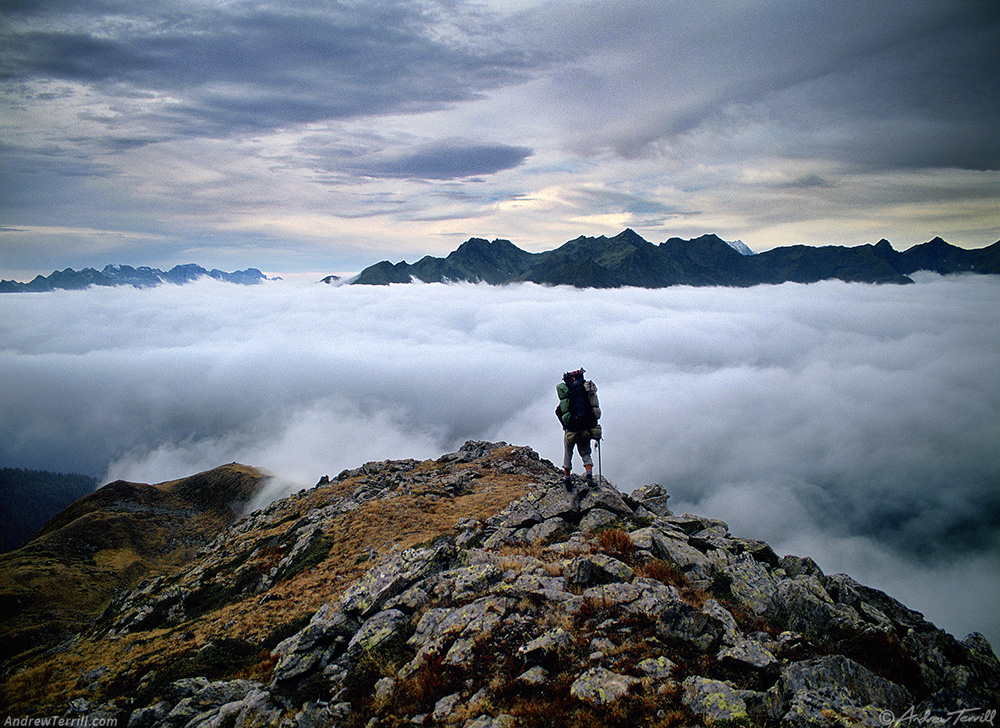
TAB: You walked 7,000 miles from Calabria, Italy, to the North Cape, Norway. What made you embark on this ambitious journey?
AT: Well, this is a BIG question, so big it took me two books to fully answer it. But, here’s the (relatively) short answer…
Partly, the journey was prompted by the accident. While lying in hospitable I found myself asking several questions. Such as: what did I want from life? Was it really what I had: a sheltered suburban existence that appeared to be primarily focused on saving up for some far-distant retirement? Or, was it what I longed for: a journey full of boundless possibility, an adventure to be lived to the full? Well, clearly for me it was the latter!
I felt at home in nature. I loved the freedom nature gave me to be myself. I loved the simplicity and sense of purpose that came from walking onward day after day. So, eventually, I quit work, although stepping off the path I’d been conditioned to follow from birth was far from easy. But, I did it, I broke free—possibly the hardest but best decision I ever made.
I spent the summer after my “alpine bounce” walking the entire length of the Alps, then the summer after that traversing the Pyrenees. But these journeys ended when summer ended, which was too soon for me. I began considering the possibility of something bigger: a journey I could lose myself in completely, something so long it could become “more than just a walk”. What I wanted was a new way of life. And thus the plan for my trans-Europe journey was born. To be honest, though, I’m not sure I’d call it ambitious. The journey was never about successfully completing a specific route or reaching a destination or walking a certain distance. My goal was simply to spend as much time in nature as I could. I didn’t go to get somewhere but to be somewhere… somewhere wild.
Of course, there were deeper reasons behind it that I didn’t understand at the time. Reasons based on both nurture and human nature. Nature called and that was why I went—I didn’t pause to wonder why. But over the miles “the why” slowly emerged. This was inevitable, I now believe. Put anyone alone in nature for long enough and they’ll start to see life very differently. Nature, after all, shaped us into what we are. It gave us our physical form, our senses, instincts, emotions, abilities. It really is our original home. Spend long enough in it and this becomes clear. My suburban upbringing had taught me to believe I was separate from nature and even “above it”. But my 18-month walk in nature revealed the opposite.
So, as I now see it, this was really why I embarked on the journey. I was called home. From this perspective my walk could be considered the most natural thing to do!
TAB: What were some of the moments that stood out for you on your walk? What was the most challenging terrain?
AT: There was so much challenging terrain it’s impossible to pick out any one stretch. There were barely penetrable forests in the Italian Apennines—a true wild side of Europe that even most Italians don’t know exist and those that do avoid! There was deep snow in the Alps; crackling cold in the Central European winter; untracked fjells in Norway with rivers swollen from snowmelt and rain sheeting down. For a continent that many people consider over-industrialized and over-developed, there was a surprising amount of challenging wilderness terrain… along with a fantastic amount of natural beauty, of course. The two often go together.
But, in truth, the most challenging terrain was inside my own head. Arguably, it was this unexpected aspect to the journey—the internal journey—that led to the hardest but also the greatest moments.
Because of the stutter I suffered, I was very much an introvert when the walk began. I’d taught myself to believe that I was better off on my own—that being alone was my nature, that I didn’t need others. As I saw it, alone didn’t equate to lonely. When I was alone in the mountains I had everything I needed. Or so I thought… until the walk’s first summer ended. But once summer became autumn then autumn slipped into winter my solitary existence began to gnaw. As nights in camp grew longer and darker and days grew colder my aloneness spiralled downward and eventually true loneliness hit. And what a torment it was, that loneliness: a black pit, by far the fiercest challenge faced. But, as with my accident, it changed my life for the better, it shook me awake. It helped me see that I did need people, that I was part of a social species. This fact was simply nature, after all. These days I’m a people person. My stutter has all but gone.
By the end of the second summer, up in the Arctic, all the truths I’d learnt about myself and nature and my place in the grand ol’ scheme of things came together into a crescendo of understanding… which I’m still benefiting from to this day. But I want to be absolutely clear: I didn’t go on the walk to “find myself”, or to understand life, or to seek transformation. And even if I had, I never would have imagined the level of transformation possible. So it’s funny, looking back at it now. I just went because I wanted to spend time in nature, and because I wanted to travel and see the world beyond London’s suburbs. There were no lofty goals!
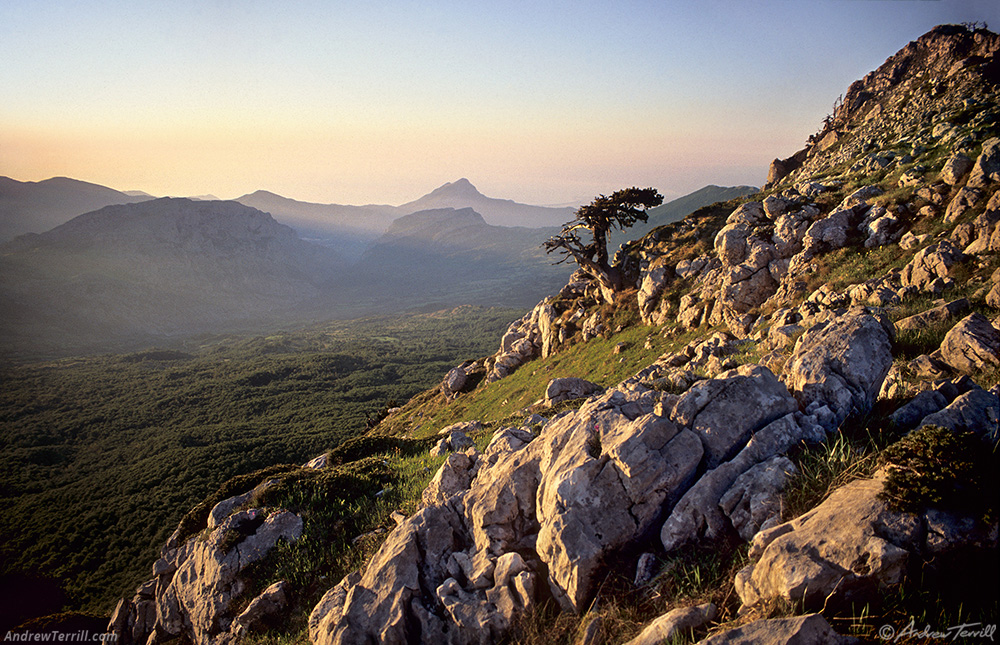
TAB: You walked the length of Europe in 1997-1998, and your books were published in 2021 and 2022. But they are so vividly written that they read as if they are about something that happened in the recent past. How did you manage to remember your walk so well?
AT: Well, the walk wasn’t like the life of routines that preceded it. Instead of being repetitive, every single day was filled with new experiences, new people, new places. Plus, many of the experiences were incredibly intense. Taken together, this novelty and intensity created indelible memories. Even today, 26 years later, much of the walk still feels as though it occurred only yesterday. It is remarkably easy to step right back.
That said, the journals I kept were helpful when writing up the small details. I spent up to an hour each evening scribbling down events, conversations, thoughts, emotions. I filled 12 exercise books with notes (and some of the pages still have mosquitoes smeared upon them—how’s that for journaling!) I also had 7,000 slides to call upon when writing, visual notes from the miles. But honestly, the journals and photos weren’t essential. The key moments and emotions were too extraordinary to forget.
TAB: How much did writing your books help you understand the personal journey that you went through on your walk?
AT: It helped a great deal. I began writing shortly after I finished, but at first I struggled. I knew I had a story to tell, and I hoped it might have value to others, but I was too close to the events to be able to articulate everything they meant. Then, life got in the way: another long walk and then different kinds of journeys: marriage, parenthood, day-to-day living. It wasn’t until 15 years had passed that I began writing more seriously, and even then progress was slow. I deliberately put living life ahead of writing about life. To do otherwise would have been to reject one of the lessons the journey had taught: to live in the moment.
But the delay was all for the best. Perspective made a difference in how clearly I saw the journey. I’d had plenty of time to consider it! But the writing process made the biggest difference. To write a story worth reading I forced myself to go uncomfortably deep into the “whys”, far deeper than I’d gone while actually walking. Figuring out motives, trying to understand why I’d reacted the way I had, why events had unfolded the way they had, why a place was the way it was, why a lesson still worked the way it did even decades later, helped me understand the journey with a depth and a clarity I’d not had at the time.
It many ways, the writing journey became a continuation of the walk as though it were the second half of it. And like the first half, it delivered insights and rewards I hadn’t imagined when setting out.
TAB: In the two decades since your walk, how do you think Europe has performed in protecting its wild places? Do you think people are more aware of the importance of nature?
AT: This is hard to answer because I haven’t been back since my journey… because my path through life led, unexpectedly, away from Europe and to the Rockies.
However, I have watched from afar, and I have seen changes. Some are good. For example, some 6,500 square miles of new forest have grown since my walk. A third of Europe is now covered by trees. There are many new national parks and nature reserves; twenty percent of Europe’s surface now enjoys some form of legislated protection. And many threatened species have received help. European bison and wolf populations are growing. Chamois are spreading back through the Apennines. Brown bears have returned to the Alps.
On the other hand, society’s unsustainable way of consuming has continued. Pressures on wild lands have increased. Fragmentation of natural environments has worsened. And, of course, the climate appears to be more volatile: storms are more intense, extremes more extreme. Plant and animal species living within specialised ecological niches are finding their existence ever more precarious. Rivers are running heavier with pollutants, the air is more contaminated, many foods contain ever-greater concentrations of poison. Society has clearly come so far, but great swathes of it appear to have forgotten where it originally came from. Nature is the foundation that our very existence is built upon… but we are chipping away at it beneath our feet.
Are people more aware of nature? I can’t answer that. Only individuals can. But I can see reasons for optimism. Many people clearly are taking action. I see enlightened individuals showing restraint in their consuming and choices, and organizations fighting for species and environments that can’t fight for themselves, and landscapes that have escaped the trampling death of “progress”. Plus, I’ll never forget everything my walk revealed: that individual steps do add up, that every single day provides each one of us with yet another chance to be the very best version of ourselves we can be, that the world can be improved one tiny act at a time, and that change is always possible. This gives me immense hope.
TAB: Your photographs are stunning. You combine words and images with great facility. What does photography mean to you and how deeply has it complimented your writing? Also, how much photographic equipment did you take with you on your walk?
AT: Thank you for the compliments! When I began working on the books I didn’t know if my story or photos would have value to anyone else. I mean, I had hopes! But I didn’t know. So, to learn that they do extends the value of the journey itself.
Photography is another way of telling stories… and there are few things more human than doing that. Storytelling is an essential part of who we are and a key part of how we became what we are: intelligent, adaptive, social creatures capable of surviving the many trials of existence. Storytelling, sharing experiences, interpreting them, learning from them, growing from them—these little tricks gave us sneaky advantages over our competitors.
Telling “picture stories” is something we’ve been doing for a long time. The oldest cave paintings so far discovered were made an estimated 2,500 generations ago. Being a photographer is to continue this most basic of human traditions. I try to take photos that tell the story of a moment in nature, not merely what it looked like but more critically how it felt. This mirrors what I attempt to do with my words, to not only describe what happened but also why it happened and how it felt. This combination of words and pictures tells a fuller and richer story… hopefully! The inclusion of images in my books also meant that the text didn’t have to be excessively descriptive. After all, no one likes too much purple prose!
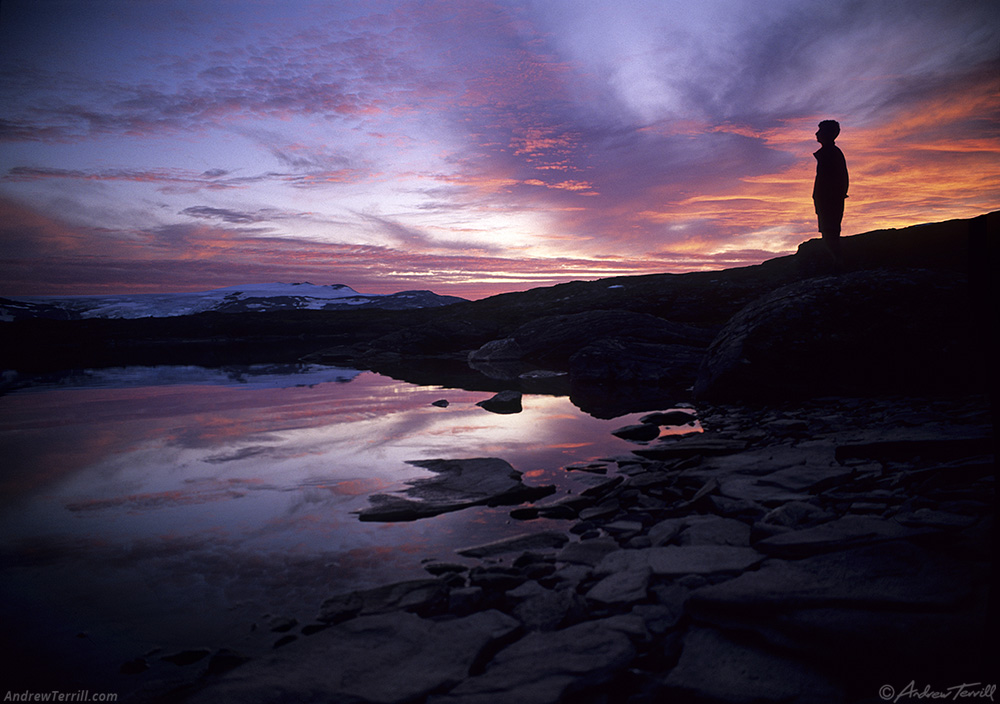
I carried a fairly heavy SLR camera during the walk, along with a large zoom lens. This increased the load on my back but I considered the weight worth carrying. Photography was (and still is) important to me. Photography can slow me down. It can help me look more closely and connect more deeply. Back when the walk took place I shot photos onto 35mm slide film. The journey took place before digital cameras existed, and before the internet exploded—before social media. I shot 7,000 slides, which might sound like a lot, but it’s only one for each mile of the journey. I collected five or so rolls of film every two weeks then posted them home when exposed. I didn’t see any of the images until after the walk was done. It was a different world back then. In photographic terms, gratification was delayed!
TAB: Could you tell us about your publisher, Enchanted Rock Press?
AT: The Enchanted Rock Press is an imprint I started myself. I did this for many reasons: partly due to the difficulty of landing a publishing deal with an established publisher (there are so many gatekeepers, and the industry has become incredibly risk-averse); partly due to the dubious benefits of working with a publisher (new authors often have to do most of the work themselves, including marketing, but only receive five per cent of royalties); but primarily for control. It’s not an understatement to say that my books were a labour of love. I’m passionate about what they say. Signing with a mainstream publisher could have meant giving up the final say over content. I would have struggled with that.
Over the past two decades I’ve connected with a broad network of publishing professionals. I was surprised, when I counted up, just how many editors I’d come to know. Several volunteered early on as beta readers, and I employed an extremely talented editor and writer, Alex Roddie, as the main editor, as well as two proofing editors after typesetting. I was a graphic designer before I became a writer, which meant I could handle all aspects of book production, so starting my own imprint and creating the books wasn’t too daunting. Of course, I’ve still got a great deal to learn about marketing… but so do established publishers, it seems! The commissioning editor of a well-regarded specialist publisher in my genre loved my books and was dead set on publishing them. But the marketing director over-ruled her. Apparently, marketing two books about only one walk was an insurmountable barrier!
But publishing through my own business has worked out well. My books are out there, being read, and this has led to the greatest of unexpected benefits: connecting with people I might never have otherwise met. I frequently receive emails from readers… and to know that others can relate to my experiences bowls me over. I wrote my story to share, and people have shared back. Connecting with readers will never grow old. Because of it, the 7,000-mile walk is still continuing, still surprising me, still bringing rewards.
TAB: How did you begin writing? Is it something you’ve always done?
AT: Writing was an ambition from an early age—in fact, from so early I can’t say when it began. Perhaps it was when I was seven and fell in love with Tolkien’s The Hobbit, a book I read then reread many times. This book might also have played a pivotal roll in my love for wilderness travel. After all, the adventure it describes is a wilderness journey, an undertaking thrillingly different from the safe suburban life I then knew. Books have such power to influence lives!
The All Creatures Great and Small memoirs by James Herriot were also hugely influential to me as a writer and as someone who craved nature. I devoured them in my early teens, falling hard for the wild landscapes of the Pennines they describe. When I went to college, I chose one close to the Pennines. The hills called! By the time college finished I’d begun writing my first book: a story about my early experiences on foot in nature. My stutter may also have played a part. As I mentioned, it’s human nature to tell stories. Back then, I couldn’t tell them directly to people. But I could at least write them.
Once I’d finished that first book I began searching for a publisher, but didn’t find one—fortunately, I now believe! Publishers told me that they liked my work, but that it wasn’t “quite right” for them… and I can now understand why. Rereading my first book I can see I had much to learn!
But this failure only pushed me to work harder. Over the next 15 or so years I developed my craft through writing features for several outdoor-focused magazines. One of them, the UK-based The Great Outdoors, was especially supportive. They published everything I sent, rarely changing a word. I made it a point of pride to submit work so polished they couldn’t find anything to edit! This, of course, took a significant amount of work, thousands of hours, most of them unpaid. But, ultimately, it paid off. It turned me into a writer.
And it’s now led full circle. I’m currently editing a book that another author wrote, a hiking memoir that inspired me when I was 18 but has long been out of print. To work closely with an author who became a hero of mine 36 years ago and is now a friend is quite something! My own writing journey continues as well… primarily because the journey that is life continues. For me, writing is an essential part of living life and an essential part of understanding it. It’s an exploration that leads to growth. My words have had great personal value regardless of how often others have read them. The benefits of writing cannot be overstated… exactly like the benefits of being in nature!
TAB: I loved both your books and found them inspiring. Thank you for sharing your thoughts.
Read my review of The Earth Beneath My Feet and On Sacred Ground.
 Talking About Books
Pingback: From Calabria, Italy, to North Cape, Norway: A Walk through Europe’s Wild Places – Talking About Books
Pingback: The Best Books of 2024 – Talking About Books