
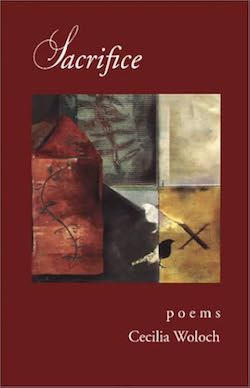
Published by Tebot Bach, 1997, 95 pages.
“I wonder if any life goes far enough to ever heal itself.”
The vivid and sensual poems tell the story of a woman from childhood to adulthood. They act as snapshots, highlighting important moments of her life.
The poems in the first section are about childhood, life seen through the eyes of a child as she grows and begins to understand the world. In “Flight”, the prose poem that starts the collection, the child discovers that the adults have fears and worries that she is completely unaware of. The girl overhears her mother tell her father about a frightening dream she had, a dream where her children are carried away by a storm. “How was I blessed to never know my mother was so afraid?”, the girl wonders. Listening to the conversation between her parents, she feels “terrified, loved. Knowing that anything could happen, suddenly; knowing the clock on the stove was turned to a time I couldn’t tell.”
Her father looms large in her life, as fathers often tend to do, especially as a child: his strength reassures and frightens her at the same time. In “The Pick”, she describes him breaking up concrete steps, “his arms flying like dark wing over his head”.
“I took for granted the power of him,
though it frightened me, too.
I watched as he swung the pick into the air
and brought it down hard
and changed the shape of the world,
and changed the shape of the world again.”
When we meet her father many years later, at the end of his life, he is in hospital, dreaming “his life over again / his mouth trembling around some lost word”.
The second section follows the arc of her marriage: the young couple, their maturing love and the slow dissolution of the marriage. She and her husband (and later ex-husband) meet at the Mexican restaurant they always go to. “We planned our wedding here, years after that / and we’ve kept coming back to plan our divorce.” Each of their meetings is full of reminders from the past and the pain of the present, “the wound / where he lives”.
The third and final section is about older generations making way for the younger ones. The book ends with another prose poem, “The Partiarch”, where the entire family—three generations by now—gather for a family photograph. “The grandchildren wail, then set free, they all fly.”
The book is full of echoes like this, encounters that reverberate, relationships that blossom and the die or fade, but become an intrinsic part of who you are. Sacrifice is a sort of memoir in poems, the testimony of a life. It is also an ode to how life continues and renews itself, in spite of loss and pain.
 Talking About Books