
Translated from French by Howard Curtis
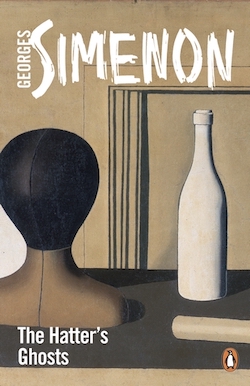
Published by Penguin, 2022, 196 pages. First translated into English in 1960. Original version published in 1949.
“It was the third of December and still raining. … In fact, for the last twenty days, it had been raining almost without interruption.”
It started raining in the small French town of La Rochelle on 13 November, the day an old lady was murdered—the first of three, all women around the same age. The police have not been able to catch the murderer.
Léon Labbé is a hatter and a man of regular habits: he has an invalid wife, a woman who refuses to see anyone at all or leave her bedroom. Every evening, M. Labbé, having checked on his wife, goes out to the Café des Colonnes to meet his friends. And every morning, when he opens the shutters of his shop, he greets Kachoudas, the tailor who lives opposite him.
One evening, Kachoudas, who also goes to the Café des Colonnes, notices something on Labbé’s trousers and bends down to remove it. It is a fragment of a newspaper, carefully cut out with scissors. Looking at it, it dawns on Kachoudas that Labbé is the murderer, who has been corresponding anonymously with the journalist reporting on the case, using letters cut out from a newspaper.
Labbé notices Kachoudas’s reaction and knows that he has been found out. He is not worried about the tailor, a foreigner who tends to keep to himself. And Kachoudas is physically small and frightened by his discovery, while Labbé is a big man, well-known and well-respected in the community. In fact, Labbé almost relishes the fact of his discovery.
The book is told from Labbé’s point of view. Georges Simenon feeds the reader facts little by little, so the reader’s initial impression of Labbé as a well-respected citizen disintegrates into something more sinister. Simenon takes you into the mind of a murderer, who sincerely believes that he is sane and that his victims need to be eliminated.
But Labbé’s scheme, which has been meticulously planned and executed with complete confidence, hits a snag. This throws the hatter off balance—something not even Kachoudas could do—and he starts to unravel.
This is a scary journey into the mind of a man who is clearly mentally unstable, although his narration is, for the most part, coherent and seemingly sane. For most of the book, it is this disconnect between Labbé’s air of rationality and the story he tells that is unnerving. When he starts to deviate from his routines, you know he is falling apart. His routines were necessary to his sanity and to his hold on reality.
Simenon’s vivid writing makes La Rochelle and its inhabitants come to life—I could feel the rain and the cold, picture the streets, and sense the fear among the people. Labbé, from the window of his bedroom, can see into the tailor’s workshop, and the way Simenon describes it means that that room feels as familiar to me as it must have been to Labbé. Simenon has an understanding of the seamier side of human nature, something that is a hallmark of his writing.
I have read many of Simenon’s books—mostly, but not all, from his Maigret series—but this is the one I like best. It does not make for comfortable reading, but Simenon’s portrait of Labbé feels so real that you are pulled into his world.
An excellent book from a writer who is a master of his craft.
 Talking About Books
Pingback: The Best Books of 2024 – Talking About Books
Pingback: On the Trail of Crime around the World – Talking About Books