
Published by Raven Books / Bloomsbury Publishing, 2024, 332 pages.
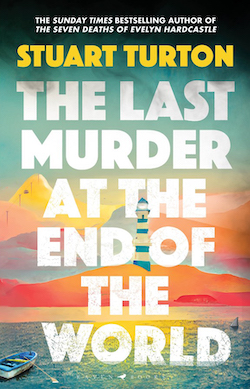
It is the end of the world as we know it.
A black fog has swept through the world, destroying every living thing in its wake: “the fog kills anything it touches…Unfortunately, it covers the entire earth, except for our island and half a mile of ocean surrounding it.”
The only place of safety is an island around which scientists have managed to create a protective shield that keeps the fog at bay.
The scientists—Niema, her son Hephaestus, and Thea, known as the elders—live on the island among 122 villagers. Niema is the only one of the three who is really a part of the village community. Hephaestus lives outside the village and avoids having anything to do with the villagers if he can help it. Thea trains apprentices who are sent out to explore the island, expeditions that are often dangerous. Not all of them survive.
An apprentice who died on one of these expeditions is Emory’s husband Jack, who drowned when Thea sent him out to sea, knowing it was dangerous. Emory has never forgiven Thea for Jack’s death. And now her only child, Clara, has joined Thea’s team, and Emory does not trust Thea to keep her safe.
The villagers live as a community, eating together and helping one another. There is a complete lack of violence, so much so that detective novels are kept hidden from them (only Emory is allowed to read them). They seem to lead fairly contented lives.
But as you read on, you realize that their lives are not completely normal, and you have the same questions that Emory has—Emory, the only villager who questions the things that everyone else takes for granted. Why is it that the villagers wake up in the morning with cuts and bruises that they did not have when they went to bed? Why aren’t the villagers allowed to explore the island without permission from the elders? Why do they die at 60, regardless of whether they are sick or not?
The villagers do not like her questions, and Emory cannot understand why. Her grandfather points out that the villagers just want to be happy, given the apocalypse that has overtaken the rest of the world. “I’m not trying to change that”, says Emory. “And, yet, answers nearly almost always do”, he replies.
He is right. As Emory learns the answers to her questions, she starts to understand the truth behind what they have been told by the elders. And as we learn more about the island, our sense of what is true also shifts. (One of the delights of Stuart Turton’s books is that the reader is constantly wrong-footed.)
The book is recounted by an omniscient narrator. Except that in this case, the narrator is truly omniscient. She is Abi, an entity who has access to everyone’s thoughts and dreams, and can communicate with them through their minds.
One day, Niema is found dead in a partially burned warehouse. Because there is no violence on the island, the murder of Niema is a huge shock. Why was she killed? Emory knew that Niema was going to conduct an experiment, and if the experiment failed, Niema would have to do “something unforgiveable”. What was the experiment? Was she murdered to prevent it going ahead?
To compound the problem, Niema’s death has resulted in the lowering of the barriers, leaving the island and its inhabitants vulnerable to the destructive fog. The only way of getting the barriers back up is to find the murderer within 107 hours, or it will be too late to save the island.
But finding the murderer will not be easy. Everyone on the island has had their memories of the previous night erased—Abi is able to do that—so even the murderer would not remember committing the murder. It falls to Emory to investigate and unmask the killer before it is too late.
This is another absorbing book from Turton, his third one and completely different from the other two. The first one was a cross between Agatha Christie and Groundhog Day; the second was about a haunted Dutch East India Company ship; and this one is sci-fi (and also cli-fi?). What the three books have in common are the twists and turns that keep the reader guessing.
Turton is good at world-building, and this book is no exception. You get a real sense of the island and the village, its terrain and the secrets it holds, secrets that Emory is determined to uncover.
The mark of good science fiction is that, although it is set in the future, it raises questions about the way we live now, seeing the present from a different perspective. In short, it makes you think, and The Last Murder at the End of the World certainly does. It is also a rollicking read—I wouldn’t expect anything less from Turton—and a story that stays with you long after you’ve finished the book.
Note: The book also has one of the nicest acknowledgements I’ve read.
 Talking About Books
Pingback: The Seven Deaths of Evelyn Hardcastle: Stuart Turton – Talking About Books
Pingback: The Devil and the Dark Water: Stuart Turton – Talking About Books
Pingback: Keeping Readers on Edge: An Interview with Stuart Turton – Talking About Books
Pingback: Stepping through the Looking Glass: A Journey through Speculative Fiction – Talking About Books