
Published by Pushkin Vertigo, 2022, 350 pages.
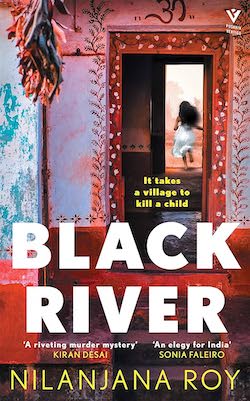
The best crime fiction is more than just a whodunnit—it shines a light on the darker side of society. This is true of Nilanjana Roy’s Black River: it is dark, heart-breaking and ultimately redemptive.
Munia is a little girl who lives with her father Chand, a farmer, in Teetarpur on the Aravalli range on the Delhi-Haryana border. On Munia’s birthday, father and daughter share a slice of cassata ice cream, which her father has bought specially for her. Then he goes off to the fields, leaving Munia to explore the environs of the village on her own, as she has done so many times before.
This time, however, Munia sees something she should not have seen. The result is that when Chand returns home, he finds his daughter hanging from a tree, with Mansoor, a Muslim man, weeping at her feet. Chand and the other villagers jump to the conclusion that Mansoor has killed her.
The local Sub-Inspector Ombir Singh is called to the scene. He manages to get Mansoor away before he is lynched. Ombir has his doubts about Mansoor’s guilt: the man is badly scarred from a communal riot in Delhi and would have been incapable of stringing Munia up.
Ombir’s suspicions fall on a couple of men in the village. This investigation is taken over by Senior Superintendent of Police Ashwini Pilania—referred to by the villagers as the “Delhi boy”—who is sent to investigate the crime, and Jolly Singh, a landowner, who takes a personal interest. Pilania agrees with Ombir’s doubts about Mansoor being the culprit. But who could have committed such a terrible crime?
This story is not just about Munia’s murder, but is also the story of Chand: how, as a young man, he left Teetarpur because he did not want to be a farmer, and went to Delhi to look for work. He ended up living on the banks of the Yamuna river, working for a butcher, Badshah Miyan. His best friends are a Muslim couple, Khalid and Rabia, who also live on the Yamuna. Chand eventually moves back to Teetarpur, becoming a farmer after all, and raises Munia, his only child, after his wife’s death.
Munia was the centre of his world. And now he must try and find her killer and avenge her.
Roy’s writing is vivid, bringing the village to life—the hierarchies, the daily routines and the power games. In the section on Delhi, Roy writes about the poor, the people who work at essential jobs that keep the city going, but are often unnoticed, people such as Chand, Khalid and Rabia.
“An invisible tide courses through the city, Chand knows. Every morning, the tide sends in a flood of people who work to build Delhi’s roads and homes, to guard the factories and offices of the wealthy, sends in artisans and labourers, armies of domestic workers and clerks, mill workers and gardeners, and every evening, the tide ebbs, casting them back outside the city, strewn like human debris across the river banks, the floodplains, the unstable islands that appear in one season, and vanish or broaden in time.”
Chand is the centre of the book: a decent man, kind and fair-minded, he is devastated by his daughter’s death. Roy’s description of his grief is heart-rending: he shuts himself in his hut at night, going back to a time before the tragedy. “The past is safe. He ignores the people outside, who glance timidly into his room. Locked into his silence, he lets his memories return to a time that is also safe, because it was before Munia was born.”
I loved this novel. The characters are nuanced, and it has a strong sense of place—both Teetarpur and Delhi are characters in themselves.
Black River is much more than a straightforward crime novel. It deals with communal tensions, rising religious intolerance, the trafficking of children, and the struggles of ordinary people.
Roy writes about the vulnerable, and the deep emotional scars that people carry within them. This is a beautifully written story about friendship, grief, and the quest for justice, justice that might not come from those expected to provide it.
 Talking About Books
Pingback: A Focus on Outsiders: An Interview with Nilanjana Roy – Talking About Books
Pingback: The Best Books of 2024 – Talking About Books
Pingback: On the Trail of Crime around the World – Talking About Books