
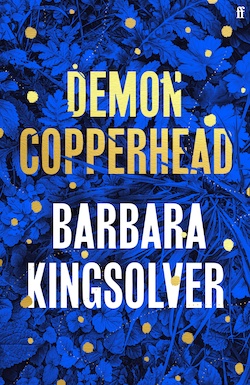
Published by Faber / HarperCollins, 2022, 548 pages.
“My thinking here is to put everything in the order of how it happened, give or take certain intervals of a young man skunked out of his skull box, some dots duly connected. But damn. A kid is a terrible thing to be, in charge of nothing. If you get past that and grown, it’s easiest to forget about the misery and pretend you knew all along what you were doing. Assuming you’ve ended up someplace you’re proud to be. And if not, easier to forget the whole thing. So this is going to be option three, not proud, not forgetting. Not easy.”
This is the story of Damon Fields as narrated by him. With light-green eyes and red hair inherited from his Melungeon[1] father who died before he was born, he becomes known as Demon Copperhead.
Demon has to, quite literally, fend for himself from the very beginning. As he says, “the worst of the job was up to me, my mother being let’s just say out of it”—in other words, his mother, a junkie, was passed out on the bathroom floor of their trailer home as Demon made his entrance into the world, still in the amniotic sac, “trying to punch himself out of a bag”.
In spite of the odds stacked against him, Demon is a fighter, and he survives with help from Nance Peggott, his neighbour. As he grows up, Mr. and Mrs. Peggott give him the semblance of a steady home, and their grandson, known as Maggot (Maggot’s mother is in prison for killing her boyfriend) becomes his best friend.
Demon has a hard life, to say the least. He is born in poverty to a weak mother and has to be the adult in the relationship. The reference to a child being “in charge of nothing” in the quote above is telling: a normal childhood implies that you do not need to be in charge of anything—that is taken care of by the adults. But for Demon, this is never the case. As he says, “The wonder is that you could start life with nothing, end with nothing, and lose so much in between.”
His mother remarries, and his stepfather, Stoner, is a brute. When she dies, the state’s child care system takes charge of Demon. He is sent to live with Crickson, known as Creaky, a farmer who takes in orphans for the money and has no scruples about making them miss school to work on his tobacco farm. Demon manages to get away and find his paternal grandmother, Betsy Woodall, who sends him to live with Winfield, a teacher and football coach. There he meets Angus, Winfield’s daughter, who becomes a close friend. Angus is strong and clear-eyed, and keeps Demon grounded.
This is a time of triumph and calamity: Demon is good at football and—for the first time—becomes popular at school. But then addiction—something he avoids because of his mother—pulls him in. He is prescribed opioids for a bad knee injury, and gets hooked, not helped by the fact that his girlfriend Dori is also an addict. Demon falls back on his artistic talent which gets him a job on the local paper drawing a superhero comic strip.
The fact that Demon survives everything that life throws at him shows a certain indomitable force within. Although he has plenty of anger, he also has empathy, and an ability to see beyond what is obvious. In Demon, Barbara Kingsolver has created a memorable character. What could have been a fairly depressing story becomes an engaging one through his narration and his voice: smart, funny, observant and wise beyond his years.
Kingsolver has taken Charles Dickens’s David Copperfield from early Victorian England to present-day Southern Appalachia during the opioid crisis. She stays quite close to the original, and many of the characters echo their antecedents, even in their names: Dora in David Copperfield becomes Dori in this book, Peggotty is Peggot, Betsy Trotwood is Betsy Woodall and so on. The main difference between the two is that Demon Copperhead lacks Dickens’s sentimentality. Here even the good characters are flawed, which makes them more believable.
Demon Copperfield echoes Dickens’s preoccupation with social justice and the conditions endured by impoverished children, especially when they fall into the hands of the state child care system. The Department of Social Services, for example, makes very little effort to check on Creaky and how the boys are being taken care of—or whether they are being taken care of at all.
Kingsolver is from Southern Appalachia herself, and in this book, she puts the Appalachian community at the centre, a community that has often been marginalized. The opioid crisis has hit the community hard, something that comes through vividly in this novel.
This is an ambitious book, and Kingsolver pulls it off. I love her writing and Demon Copperhead is, in my opinion, the best thing she’s written since The Poisonwood Bible. It’s the sort of book I want to give to friends. There is just so much to enjoy: the characters, the writing, the story itself. It is, quite simply, brilliant.
[1] Melungeons are descendants of people of mixed ethnicity in the southeastern US, notably in Appalachia.
 Talking About Books
Pingback: The Best Books of 2023 – Talking About Books
Pingback: The Best Books of 2024 – Talking About Books
Pingback: Best Books of 2025 – Talking About Books