
Published by Faber & Faber, 2021, 116 pages.
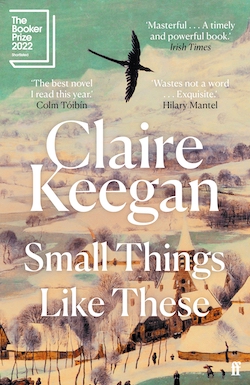
1985. It is almost Christmas in New Ross, a small town in Ireland. Bill Furlong, a coal and timber merchant, is making his deliveries before the holidays. The bitter cold means that he has a lot of orders to fill.
Furlong is the son of an unmarried mother, a stigma in those days. But his mother’s employer, Mrs. Wilson, instead of throwing her out—as most others would have done—kept her at home and helped raise the child. Mrs. Wilson was a war widow and had no children, and did not really care what people thought. Furlong’s mother was Protestant and Mrs. Wilson Catholic, but that was never an issue.
Furlong is now married and has five girls of his own. Although his business is doing well in terms of orders, he does not have a lot of money—many of his clients are not well off and often pay him only when they can. The girls are bright and doing well in school, and he is proud of them.
His rounds take him to the convent of the Good Shepherd. The convent also runs a training school and a laundry. The laundry has a good reputation—whatever goes in there comes back spotless and looking like new. But there is talk about the place: that the girls are there because they have become pregnant outside wedlock; that the training school does not exist and the girls are instead worked to the bone at the laundry; and that the nuns take away their babies and sell them for adoption. But no one does anything about the laundry or tries to help the girls: the Catholic Church is still a powerful force in Ireland.
When Furlong goes to the convent for a delivery, the nuns are not around, so he opens the coal shed to leave his load. He finds a young girl who had been locked in there in spite of the cold. He covers her with his coat and takes her back to the convent. Something about the way she is received by the nuns feels odd to him, and he starts to suspect that the Good Shepherd convent might not be as charitable as it seems.
In this slim book—just over 100 pages—Claire Keegan tells a powerful story about a man and his conscience, and his desire to do the right thing when so many others simply look away. Furlong is very aware that, if Mrs. Wilson had been like the others, his mother would have ended up in a laundry like this and who knows what would have happened to him.
I loved Keegan’s writing. She conveys so much without needing to go into long descriptions: “blades of cold slid under doors and cut the knees off those who still knelt to say the rosary”. She captures the relationship between Furlough and his wife Eileen, mostly through dialogue. Nothing here is extraneous.
There is a harrowing scene when Furlong is at the convent—a visit before the one where he discovers the girl. He is approached by a girl in socks with no shoes to protect her from the cold and whose hair looks like “someone blind had taken to it with shears”. She asks him to take her with him; she needed to get out of the convent. “Just take me as far as the river”, she says. “[A]ll I want to do is drown meself.”
Keegan hints at what went on in the Magdalene laundries, giving us only the details that Furlong would have known. The truth about the laundries came out much later—the last one closed in 1996. These so-called training schools were places where pregnant unmarried girls were sent. Their families wanted to have nothing to do with them and thought that the girls would at least get some sort of education. But the nuns had no intention of educating them: they worked the girls like slaves. While some of their babies were sold into adoption, others were left to die.[1]
This is a brilliant and moving book. It is not just the story that Keegan tells but also the way she writes. Read this book. It is one that will stay with you.
Note: If you’re interested in the repercussions of the Magdalene laundries, I would recommend watching The Woman in the Wall, a BBC six-part series created by Joe Murtagh, starring Ruth Wilson and Daryl McCormack.
[1] You can find more information on the laundries here: http://jfmresearch.com/home/preserving-magdalene-history/about-the-magdalene-laundries/. The sheer number of lives ruined is staggering.
 Talking About Books
Pingback: The Best Books of 2022 – Talking About Books
Pingback: The Best Books of 2024 – Talking About Books