
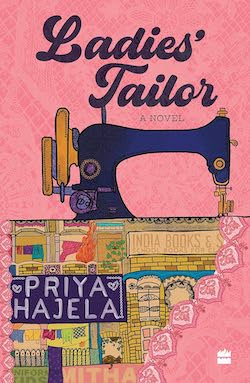
Published by Harper Collins, 2022, 295 pages.
“The people, the smells, the voices, the yearning, the hands clutching bellies—for that’s where their few precious belongings were—the odour of fear, the taste of dislocation, the sounds of desperation: that is what Gurdev sensed all around him when they reached Lahore station.”
In 1947, when India was partitioned into two countries—India and Pakistan—there was a mass movement of peoples across the new borders. It was a time of violence, of dispossession, of refugees. In Ladies’ Tailor, Priya Hajela tells the story of Gurdev, a Sikh from Lahore in what is now Pakistan, who tries to make a new life for himself in India.
Gurdev has turned his back on his education and his parents’ plans for his future by marrying Simrat, a woman from the village where he lives. Gurdev knows that his village will go to Pakistan after Partition, so he plans his family’s move to Delhi before it happens. He goes to see his estranged parents in Lahore to persuade them to come with him but they refuse. Gurdev knows that, with the massacres taking place on both sides of the border and the communal unrest, they would not be safe. However, there is nothing he can do, so leaving them behind, he crosses the border with his wife and children.
The family is placed in a refugee camp near Delhi with thousands of others. Here Gurdev gets to know two Sikhs: Nirmal, a tailor with a reputation for making excellent women’s clothes, and Sangat, Nirmal’s friend.
One day, without warning, Simrat leaves him, taking their two sons. Gurdev is upset and bewildered—he cannot understand why she has left. But he is essentially a practical man and a planner, and soon he has a project: Nirmal and Sangat are going to start a women’s clothing store, and they want Gurdev to join them.
With the compensation they get from the Indian government for losing their businesses in Pakistan, the men open a shop. They use khadi, a hand-spun material made of natural fibre (usually cotton but which sometimes includes silk and wool). Because of the movement against wearing imported cloth, there is a market for khadi.
The best khadi available—Gurdev and his colleagues want nothing but the best—is woven in secret by Muslims who have decided to stay on in Delhi. But with communal tensions brewing, many of these people are hiding with their Hindu neighbours. The man Gurdev speaks to is a Hindu who represents seven of these families. “The women of the house are spinning khadi yarn out of raw cotton and the men are weaving it into fabric, all behind closed doors. I sell the cloth in the market, but nobody knows the source.”
The shop does well, but Nirmal feels that the clothes he makes need an extra something, such as exceptional embroidery. When he was in Lahore, Nirmal had got to know two young Muslim boys, Sultan and Samir, who used to embroider clothes for him. They were true artists, Nirmal tells Gurdev, and the quality of their work was unmatched. Since Nirmal and his wife could not have children and the boys were orphaned, the couple had treated them like their own sons. But the boys were now in Lahore, and Nirmal wants Gurdev to help him bring them to India.
So Gurdev now needs to journey back to the land he has left, a journey that is not going to be easy. To pose as a Muslim, he cuts off his long hair and shaves his beard, something Sikhs are never supposed to do. He is accompanied by Noor, a Muslim woman living on her own in Delhi, who is a regular customer at the shop and has become part of the family. Noor is feisty and independent and offers to pose as Gurdev’s wife, which would make the trip less suspicious.
But for Gurdev, going back means reopening wounds that have barely healed, and facing up to events that took place before he left. Would they be able to get the boys out without the knowledge of the authorities? And, if they did succeed, how would the boys fare in India?
This book feels very real. Hajela captures the atmosphere at that time in both India and Pakistan: the difficulties, mutual mistrust, and memories of great suffering. The book takes you into the lives of the people on both sides of the border.
Hajela also writes knowledgeably about women’s clothes: the way you can tell, just by the cut of the salwar[1], which side of the border the woman is from.
Hajela’s paternal grandparents were among those who moved across the border to India during Partition, so the story has a personal resonance for her. She has based Nirmal’s Ladies Tailor shop on a real one in Ludhiana in Punjab, which was also started by refugees from Pakistan.
This is a book with heart, and brings alive a time of great sorrow but also of new beginnings. I enjoyed the book and look forward to reading more from Hajela.
[1] Loose, pleated trousers, worn with a tunic (kameez).
 Talking About Books
The embroidery of Punjab is a reflection of the state’s rich cultural tapestry and artistic heritage. Phulkari Embroidery, Bagh Embroidery, Aari Embroidery, and Chope Embroidery exemplify the skill and dedication of the artisans who have preserved and enriched these traditional forms over the years. These exquisite embroidery styles not only contribute to the visual splendor of Punjab’s textiles but also serve as a testament to the enduring legacy of craftsmanship in the region. As we celebrate the diversity of Indian textiles, the embroidery of Punjab stands out as a beacon of tradition and artistry.
https://www.indianetzone.com/41/embroidery_punjab.htm
Thank you for sharing that. India has such a rich tradition of textiles.