
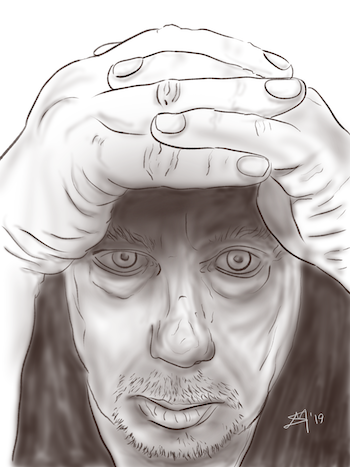
Slavko Milekić is a Serbian author, artist, translator and neuropsychologist, who now lives in Mexico.
His books include Word Beads (2019), a collection of short stories, which he also illustrated; and The Theory of Language (1999), which he cowrote with Steven Weisler.
Slavko teaches Cognitive Science and Digital Design at the University of the Arts in Philadelphia.
Talking About Books asked Slavko about writing in two languages and drawing on his own life for his fiction.
TAB: In Word Beads, you wrote some of the stories in Serbian and some in English, which you then translated into English and Serbian respectively. Why did you choose to write in both languages? Does the language you use affect the way you tell the story?
SM: Language certainly plays a role. I come from a family of translators. My mother translated the works of Henry James and J.D. Salinger (among others) and my father translated the works of Freud and C.G. Jung from German. He learned both German and Russian while interned in a concentration camp during World War II. So, I also started translating while I was only 14 (when I learned English by spending a year in the US). While studying medicine in Germany, I also learned German. I’ve translated probably more than 20 books from English and German into Serbo-Croatian, including Richard Bach’s Illusions: The Adventures of a Reluctant Messiah.
So, how does language affect my writing? Well, it is mostly chronological. When I write about events that happened during my early years in the former Yugoslavia, I write in Serbian. When I write about more recent events I write in English. The problem is translating them back and forth. To convey the true spirit of a story written initially in Serbian, I use what I call Slavenglish—instead of “I went” I write “I go”, instead of “I lit a cigarette” I write “I light a cigarette”. I thought that this is the most direct way of connecting to the reader. One of my degrees is in psycholinguistics, so I know that languages evolve and change. There are several beautiful books written in “Ebonics” or “Spanglish”. Maybe my writing in “Slavenglish” is a failed stylistic experiment, but it was done on purpose.
Does it affect the way I write my stories? I don’t think so. Every story has a main character, plot, climax, and resolution. It is really the art of translation that makes the story accessible to other cultures. That is why now the name of the translator is listed next to the author’s name on a book cover. For example, I have enjoyed immensely the works of Haruki Murakami that were translated from Japanese to Serbian, often before they appeared in the US. My book was recently translated into Spanish by Victoria Cantarell and edited by Jaime Salm. All my Spanish-speaking friends like it.
TAB: You seem to have drawn on your own life experiences when writing. How autobiographical are your stories?
SM: Yes, a lot of my stories are autobiographical. However, I like to insert stories about questions that fascinate me. For example, can one make a screen that would display every photo ever taken (and even those not taken). I wrote this story (hopefully for my next book) devoted to one of my favorite authors, Jorge Luis Borges, inspired by his story “The Library of Babel”.
TAB: This is your first book of fiction. What inspired you to write this book now?
SM: I have been writing since an early age, mostly stories and poetry. When I was 18, I won the prize for the best youth story. The prize was a voucher for the local bookstore where I got 20 books. My book came about when I moved to Mexico and had more free time. To me, writing is easy, and I do it almost every day. Publishing is a lot of hassle.
TAB: You moved from the former Yugoslavia to the US and had to get used to a different culture. Your story, “Birthday party in a foreign land”, is a good example of trying to understand the customs of a new place. How did this move affect you and your writing?
SM: Every move and exposure to another culture affects us. It has the potential to enrich us and help us understand humanity on a personal level. However, many people choose to go back to what they already know. Many of my friends emigrated to different parts of the world when the former Yugoslavia was falling apart. Most of them could not handle the “culture shock” and went back after several years.
I was lucky to be exposed to different cultures from an early age. Spending several months in Greece when I was only eight. Spending months in London during my teenage years. Going to Paris hundreds of times because my girlfriend was French. Then, spending several years in Germany during medical school. I spent a year in the US when I was 14. I came back when I was 33. I guess the difference was that at this time I had children and was not acquainted with child-rearing practices, which were very different from those in my country. Also, we were very poor. Hence the story “Birthday party in a foreign land”.
Now I live in Mexico and enjoy yet another different culture. Does it affect my thinking and writing? Of course.
TAB: You are an artist in your own right, and you illustrate your own stories. What mediums do you work in? Do you use digital methods and, if so, how does that change your art?
SM: Yes, I am an artist, or at least that is how I define myself. I have spent more than 15 years at the Yugoslav Academy of the Arts studio, just because it was free. As a matter of fact, one of my chalk drawings (when I was only 14) was presented to the first men on the moon—Neil Armstrong, Buzz Aldrin and Michael Collins—in the name of the children of Belgrade when they were doing their world tour. It probably has more to do with the subject matter than with my artistic talent.

I am a traditionally trained artist, and my favorite mediums were pen and ink drawings, monotypes, oil on wood, and prints. Lately I discovered the digital medium. I have an iPad with a pressure sensitive pen. As an artist I will use any medium to express myself. So, I usually start with a digital sketch, then modify it using acrylic paints, resin, markers, or anything else. People often look down on digitally created art. However, I learned that David Hockney had a resent exhibition of works he created on an iPad. So, I say, if David Hockney can do it, why can’t I?
In the past several years I had several exhibitions of my art in Serbia, US, and Mexico. Here is the link to a short video one of my students made.
Does your background in neuropsychology have an influence on your writing?
SM: Of course. Any knowledge you have influences you. I have a medical degree, a degree in neuropsychology and a PhD in cognitive science. Recently I co-wrote a short story with my friend in the fashion of “exquisite corpse”. It was a murder mystery and I used some of medical expertise to clear the wrongly accused person. So, the short answer is yes. I will use any knowledge I have in my writing.
What inspired you to start writing? Is it something you have always done?
SM: I have been writing since the time I learned how to write. Writing is a magical thing. We all have thoughts, but once we put them into words, they start really existing. And, the best thing is, you can share them. Also, putting thoughts into words forces you to be clear, and make sure you convey the meaning. It is a kind of mental gymnastics, and that is why I keep writing whether or not my stories are published. It helps me see the world and myself better.
TAB: I love the way you meld languages and images. I look forward to your next book! Thank you so much for sharing your thoughts with us.
 Talking About Books
Pingback: Word Beads—Short Stories: Slavko Milekić – Talking About Books
Orgullosa estoy tenerte de amigo..