
Translated from Russian by Lisa C. Hayden
Published by Oneworld Publications, 2020, 255 pages. Original version published in 2014.
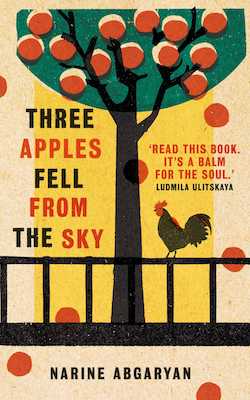
One Friday, Anatolia Sevoyants put her affairs in order and lay down to breathe her last.
She had been bleeding heavily for days, although her periods had stopped some years ago, and she was convinced she was going to die. But she does not die that Friday.
Anatolia lives in Maran, a village in the mountains of Armenia, where, at 58, she is the youngest resident. Her next-door neighbour Yasaman is a healer who might have been able to help her, but Anatolia does not want to go to her because she is afraid that Yasaman would panic and call an ambulance to take Anatolia to the hospital in the valley. Anatolia definitely does not want to go to hospital. “She had decided to die with her dignity and tranquillity intact, in peace and quiet, within the walls of the home where she had lived her difficult, futile life.”
Anatolia was the only one of her family to survive to middle age. The women in her family died young: her mother passed away when Anatolia was seven, and none of her sisters survived. Her father, devastated by the death of his wife, left home and never returned.
Anatolia eventually married, but her husband was abusive. Now she is a widow, content to be alone with her chickens. But the blacksmith Vasily, also a widower, has his eye on her, and Yasaman and her husband think that the match would be good for Anatolia as well as Vasily. When Vasily asks her to marry him, Anatolia, fully expecting that she will die in the next few days, says yes. Vasily is delighted and starts to make arrangements. And Anatolia does not die.
This is a lovely, gentle book that follows the villagers of Maran as they deal with pain, joy and everyday life. Divided into three parts, the book starts with Anatolia’s story. We learn about the curse on Anatolia’s mother which can only be kept at bay by her long thick hair, something that is passed on to her daughters.
Some years ago, there was a catastrophe in Maran. A section of the cliff had collapsed, taking with it several households. Only one house remained standing at the edge of the cliff. This is Vano and Valinka Melikant’s home, which miraculously survived the earthquake. Their story comprises the second section of the book.
Vano and Valinka’s grandson Tigran has, like all young people of Maran, gone to the city to earn a living. There he meets and marries Nastasya, with whom he has a child. After the death of his beloved grandfather, Tigran and his family visit Maran. Valinka is not sure how Nastasya, a city woman, is going to find village life, but she fits in, and you get a picture of the village as seen through Nastasya’s eyes.
The final section comes back to Anatolia and Vasily (and a ghost who visits Vasily to bring him some news).
I enjoyed this book very much. Narine Abgaryan paints a vivid picture of Maran, making the reader feel that they are part of this community. The book takes its time to tell the story, and its language picks up the everyday rhythms of life in Maran, which Lisa C. Hayden does justice to in her translation.
When Nastasya is with the women in the fields, she notices that “the air was golden and damp, and it smelled sharply of spicy herbs Nastasya didn’t know the names of. She breathed deeply and freely, adjusting herself to the measured pace of existence here that was so new to her. Everything around her was permeated with it, beginning with the ancient forest surrounding Manish-kar’s crown, where each tree seemed to speak its own language, and ending with the people.”
This sense of timelessness is echoed when Nastasya goes to Valinka’s attic: “the spacious attic was stuffed full of so many worn-out old items that it felt like a place that time had not simply stopped but become confused and dozed off”.
Through the lives of the villagers, you learn of the hard times they had been through, the times when food was scarce and people just about survived. You learn about their resilience and the strong ties that hold the community together (and keep grudges alive).
If you need a break from the frantic pace of everyday life, read this book. It is a delight. I will end with a quote:
“[A]nd may it always be thus, so the night will cast spells, protecting her happiness, and three apples will roll along night’s cool hands and later, as has been established in Maran legends since time immemorial, the night will drop them to earth from the sky: one apple for the one who saw, another for the one who told the story, and a third for the one who listened and believed in what is good.”
 Talking About Books
Pingback: The Best Books of 2023 – Talking About Books