
Published by Harper Collins / Minotaur Books, 2021, 383 pages.
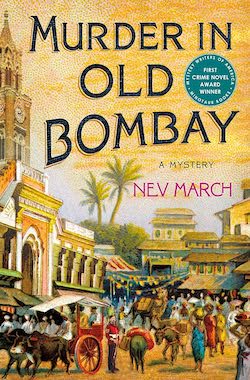
Bombay, 1892. Bacha and Pilloo, two young women, fall to their deaths from the city’s clocktower. The police conclude that it was suicide.
Captain James Agnihotri of the British army is recovering in hospital in Bombay after a skirmish in Karachi with the Pathans, a skirmish where many of his men were killed. He sees a news item about the two women as well as a letter from Adi Framji, Bacha’s husband and Pilloo’s brother, insisting that they did not commit suicide. Moved by the letter, James decides to find out more.
The Framjis are a prominent Parsi family, and James—who has by now left the army—is hired by Adi to look into the women’s deaths. It is soon quite clear that Adi was right and the women were murdered. As James probes deeper into the case, he seems to be making some powerful people very nervous. He is attacked on the street, and a man breaks into the Framji household, looking for something.
James meanwhile is treated almost as one of the Framji family and moves into their house for a while. James is an orphan: he never knew his English father, and his unmarried Indian mother was disowned by her family when they discovered she was pregnant. She died when James was very young, and he grew up in an orphanage.
So the Framji family becomes precious to him, something compounded by the fact that he falls in love with Adi’s younger sister Diana. But the father, Burjor, wants his daughter to marry a Parsi. “Two brides were lost to us…to my clan, Captain”, he explains to James. “We cannot lose another!…Our customs are all we have.”
Meanwhile, Diana wants to be involved in the investigation, and she is not someone who is easily dissuaded, although the men are worried that she is putting herself in danger.
And why are the British authorities interested in this case? Is the Rani of Ranjpoot involved in the death of the two women? If she is—and if James can prove it—then she would be judged an incompetent ruler, and the British would send the army into Ranjpoot, which would then become part of the Raj. So if the Rani is involved, she has a lot at stake and would go to great lengths to keep this from happening. James also suspects that it is the Rani’s nephew who broke into the Framji house.
This book starts out as a fairly traditional murder mystery, but moves into historical fiction as James travels to Lahore to find someone from Pilloo’s past who might have a bearing on the case. While he is there, Lahore is besieged by the Pakhtuns, and with no other way of getting out, he joins a long line of refugees heading out of the city. On the way, he finds and cares for four children, Chutki, a young girl sold into prostitution, and two boys and a baby, all of whom James manages to get safely to the Framji household. Chutki is an intelligent, resourceful child, and one of my favourite characters in the book.
Nev March incorporates the history of the Indian subcontinent into the novel, for example, the 1857 mutiny and the Anglo-Afghan war. She also includes details about the Parsis and their history. Making James of mixed race means that he is able to move easily between the British and the Indians—something that helps him when he disguises himself in the course of his investigations. But because he is half-Indian, the British do not completely accept him as one of theirs (even though he is part of the British army).
This is a fun read with plenty of action and a fair bit of romance. March brings the period to life, capturing the relations between the British and the Indians, which were often a delicate balancing act. The fact that the action goes beyond Bombay makes it more interesting and more than a traditional crime novel.
 Talking About Books