
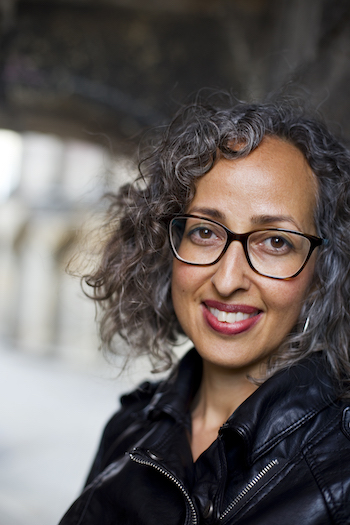
Sofia Samatar is an American author, of Somali and Swiss-German Mennonite descent.
Her books include The White Mosque (2022), which won the 2023 Bernard J. Brommel Award for Biography & Memoir (Midland Authors Book Award), and was a finalist for the 2023 PEN/Jean Stein Book Award.
In 2014, her epic fantasy A Stranger in Olondria (2013) won the British Fantasy Award for Best Novel (the Robert Holdstock Award), the William L. Crawford Award and the World Fantasy Award.
Her other books include Monster Portraits (2018), an exploration of monsters in collaboration with her brother, the artist Del Samatar; Tender: Stories (2017); and The Winged Histories (2016).
Talking About Books interviewed Sofia on The White Mosque and her interest in ancient poetry.
TAB: The White Mosque tells the story of the Great Trek undertaken by a group of Mennonites in the late 1880s. Could you tell us more about this? What drew you to this story?
SS: Sure, thanks for asking! I was drawn to this story when I first read about it in a history book from the 1970s. First of all, it surprised me, because I’d never heard of this particular migration before, even though I grew up Mennonite and attended Mennonite schools. I was intrigued by this history of a Mennonite community in Central Asia, in what’s now Uzbekistan.
The story also struck me because it seemed to echo my experience in a curious way, although I am not descended from the Central Asian Mennonites. It’s the story of a Mennonite village in a primarily Muslim region, which attracted me because my own family is Mennonite on one side and Muslim on the other.
TAB: Your book is a combination of travelogue, memoir and history, moving seamlessly from one to the other. Did you plan to write it this way?
SS: I had a lot of trouble figuring out the structure of this book! There were so many fascinating stories from history, but I wanted the book to be a memoir as well, because my interest in this history was so personal. Eventually, I hit on the solution of arranging the book around my trip to Uzbekistan. Each chapter became a place, a stop along the journey. It was a great way to combine history with the present, because I was following the path the Mennonites took over a century ago, so I could reflect on their experiences, but there was also space to convey my own contemporary experience of the trip.
So you could say that the travelogue was the missing link: it allowed me to meld memoir and history.
TAB: Is it fair to say that this journey to the White Mosque has also been, for you, a journey of self-discovery?
SS: Absolutely. It taught me a lot about self-discovery, which I now see as a communal process. Discovering the self always means discovering others, because people are connected to each other through so many links—historical, cultural, genetic, aesthetic, imagined. If you want to discover yourself, I now believe, your best plan is to get very interested in someone else. You’ll be on firmer ground, for one thing. The self is so nebulous!
TAB: What struck me when reading The White Mosque were the kindnesses shown to the Mennonites during their trek by, for example, the imam of Kok Ota opening up the village mosque to the travellers so they could use it for prayer. Do you think we have lost something of that sense of compassion today?
SS: This was an incredible aspect of the story to me. The hospitality shown to the Mennonites in Central Asia, who were at times completely helpless, as well as traveling illegally, is so moving. I don’t know if I would say this sense of compassion has been lost, but it is unevenly distributed. And in fact, the situation in the past was similar, because at times the Mennonites were met with mistrust and even hostility by people who associated them with Russian imperialism.
I think their story shows that in most cases, people have a strong desire to help others in need. But this impulse can be damaged or blocked by fear and trauma. It’s also true that they were traveling in a place where hospitality is extremely highly valued, which is still the case in Uzbekistan today.
TAB: You are a Mennonite of Swiss-American and Somali heritage. How has this influenced you and your writing?
SS: This is a great question, but it’s one for the critics! I find it hard to say how anything other than reading has influenced my writing. I can tell you that I when I wrote my book, I was reading Kate Zambreno, Bhanu Kapil, Teju Cole, and W. G. Sebald. But how my heritage is involved, I don’t really know, except that it gives me an interest in certain stories, like the story behind The White Mosque. A good critic could probably give you a better answer!
TAB: You have studied Arabic, and you draw on ancient Arabic and Anglo-Saxon poems. What can these works teach us today? Do you also write in Arabic?
SS: Oh no, I don’t write in Arabic, although I would love to. I don’t translate either. I do read Arabic, and I also love reading Arabic works in translation—these days I’m enjoying the translations of Robin Moger and Yasmine Seale, who are both fantastic.
What can ancient poetry teach us? I’m tempted to answer: everything. It’s epic in scope. It has startling imagery, intoxicating music, philosophy, histories of people and landscapes, extreme pleasure and pain. It has everything.
TAB: I am interested in Monster Portraits, the book on which you collaborated with your brother. Could you tell us more about it?
SS: Sure! My brother Del is an artist—a tattoo artist by profession—who makes beautiful ink drawings of monsters. For Monster Portraits, he made drawings and sent them to me, and then I wrote about them, imagining stories and voices for these creatures. It started as a fun fantasy project, but as we continued, it became more and more real. I wound up doing a lot of research on monsters and studying them as cultural forms. As far as history can tell us, there have never been humans who did not tell stories of monsters. So the figure of the monster is clearly doing important cultural work! It was fascinating to investigate this and to work some of my research into my stories.
TAB: When did you start writing? What was the first piece you wrote?
SS: I started writing as soon as I knew how! I was four or five years old. My first book is called “Simpy and the Rat.” It’s about a little girl who wants to keep a rat as a pet, but her mother objects. I still have it!
TAB: That’s a lovely story!
I enjoyed The White Mosque and learned so much about the Mennonites and their history. Thank you for sharing your thoughts with us.
 Talking About Books
Pingback: Reliving an Old Journey - Sofia Samatar