
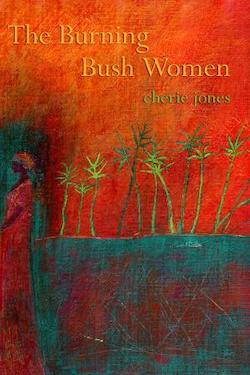
Published by Peepal Tree, 2004, 158 pages.
“We live by our hair.
“It never lies.
“We welcome rain when our plaits undo of their own volition and retreat into themselves. We are pregnant when our hair turns the colour of beetroot and are about to die when it lies still against our scalps and becomes straight and starts to drain itself of its fire. We are sick when it refuses to be ignited by sunlight.
“It is not only the hair of the affected Bush that speaks when something is about to happen.
“Our hair speaks to all of us.”
In the title story, the Burning Bush women know that something is wrong: their hair tells them that someone among them is dying. It is Enen, a woman grieving for her lover, a married man called Melkey. She is devastated by his loss, so much so that Melkey’s widow worries about her. The Bush women go to her, but she is not to be consoled, convinced that Melkey’s spirit is calling to her.
These stories—set mostly in Barbados—are about women dealing with life in all its complexities and carrying on regardless of what life throws at them. The stories are a mix of the real and the supernatural.
In “Stranger in My Garden”, 13-year-old Jane, whose English mother had returned to the UK to study, befriends Chasseyman, the odd-job man hired by her father. Only Chasseyman is a gay woman, and she becomes a mentor to Jane, who is trying to understand why her mother has left. The story is beautifully written, capturing the world from the point of view of a child. (We meet Jane again in some more of the stories, as a troubled child and as an adult.)
In “A Day of Deliverance”, Ethel lies in bed with a pair of scissors in her hands, waiting to teach her husband a lesson. “I ain’t really want to kill Carson”, she says. “Maybe just hurt him a little bit.” In “Warress”, a young girl comes to terms with the special powers she has inherited from her grandmother. In “The Doll”, a woman meets her estranged father at the airport, hoping for some kind of reconciliation.
In all of these stories, there is pain, suffering and joy, but also a lot of humour. Ethel thinks of her body, “getting old and saggy in all the wrong places, and your stretch marks singing the Hallelujah chorus that they finally free and making tracks all over your body”.
What happens when you feel unseen, unacknowledged for who you are? The narrator in “Blind”, a young girl who has moved to the US with her mother, feels invisible when no one seems to notice her. In “Anonymous”, Delores feels she is losing something of herself with every setback she encounters: her dog dies, her best friend leaves, and she is passed over for promotion. Little by little, she is beginning to disappear. But as the quiet, docile Dolores disappears, she reveals the woman she really is: Queen of the Sahara Mapusas, a fierce, proud woman.
Cherie Jones has a way of capturing character with a few brushstrokes. In these stories, Jones brings to life all these women: strong, feisty, determined, funny and brave.
“At the end of everything there is understanding.
“No horror, no hope, no pleasure, no pain.
“Just knowledge.
“Just love.”
The women in these stories stayed with me, and I kept hearing their voices long after I finished the book.
 Talking About Books
Pingback: Raising Issues of Domestic Violence: An Interview with Cherie Jones – Talking About Books