
Translated from Spanish by Margaret Jull Costa
Published by Penguin, 1995, 279 pages. Original version published in 1992.
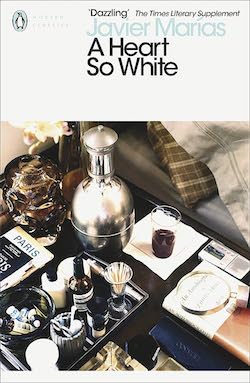
“[W]e spend our lives in a process of choosing and rejecting and selecting, in drawing a line to separate…identical things and make of our story a unique story that we can remember and that can be told.”
“Listening is the most dangerous thing of all, listening means knowing, finding out about something and knowing what’s going on, our ears don’t have lids that can instinctively close against the words uttered, they can’t hide from what they sense they’re about to hear, it’s always too late.”
A woman returns from her honeymoon, walks into the bathroom and shoots herself. No one seems to know why she did it.
The dead woman, Teresa, was married to Ranz, who eventually marries her younger sister, Juana. They have a son, Juan, who is the narrator of this book. When the book begins, Juana is dead, Ranz is a widower again, and Juan is newly married.
In spite of the way it begins—with the suicide—this is not a crime novel. It is more a meditation on relationships, the way we make compromises, come together and grow apart, and the secrets we keep from those closest to us.
The first chapter is about Teresa’s suicide. We discover Juan’s relationship to her in the last sentence of the chapter: “Everyone said how unlucky for Ranz…the husband, my father, being widowed for the second time.” Having told us this story, Juan moves on. But the suicide hangs over the book.
Juan works as a translator and interpreter, as does his wife Luisa. As a translator, he is alert to nuances, to shifts in meaning. He constantly observes and analyses everything, even his relationship with Luisa: how things change when she becomes his wife. But he can also be blind—or unwilling to see—what is important. There are things Juan definitely does not want to know. He never asks about his father’s first marriage—it is something his father never refers to—nor why Teresa killed herself. It takes Luisa to try and uncover the truth.
Teresa’s suicide is not the only incident that echoes throughout the book. When Juan and Luisa are in a hotel on their honeymoon in Havana, Luisa is unwell and in bed. The couple hear a conversation in the next room between a married man and his lover. From what they can make out, the man has a sick wife back in Spain, and the woman is tired of waiting for the wife to die. She wants him to kill his wife and threatens that if he does not, she will do it herself. At the time, Luisa pretends to be asleep, so Juan is not sure if she has overheard the conversation. They do not mention it or talk about it until much later. But Juan thinks about it often.
The narrative keeps looping in on itself. Javier Marías uses repetition to mirror the way we think and the way we worry at things. He takes a thought and follows it, teasing it out. His writing is almost stream-of-consciousness, not quite in the style of Virginia Woolf, but more measured.
An example of this is Juan recounting a conversation he has with Ranz. Juan describes his father, going into detail about his smile and the way he holds his cigarette. He thinks he glimpses grief in Ranz’s smile, which leads him to think about the way photographs fix someone forever. After the person dies and memories of them fade, it is the photograph—a particular moment in time—that is the only clear image of them that remains. Juan thinks about the photographs of his mother and grandmother, both now dead, and the grief he thinks he sees in their eyes. This in turn reminds him of his childhood in Madrid and the music of the organ grinder and how everyone would stop whatever they were doing to listen to it. At this point, he speculates, their gaze might alight on the photographs framed on the mantelpiece. And then his musing takes him back to Ranz, the point where his reflections began.
This train of thought is set in a single paragraph that goes on for three pages, and the lack of a break in the paragraph allows the reader to follow Juan’s thoughts without interruption, thoughts that reveal a lot about him and how he views the world around him.
This is a book primarily about relationships: the lengths we go to preserve them, how they change over time, and the secrets we keep. Marías looks at the nuances and shades of grey that make up relationships in all their complexity.
I am not sure I have done this book justice. A Heart So White should be read slowly, savouring the language (rendered beautifully by Margaret Jull Costa) and its ideas. If you are looking for a quick read, then this is not for you. But if you are looking for something to lose yourself in, something that will make you think and look at your own life from a slightly different perspective, then this book is for you.
 Talking About Books
Pingback: The Best Books of 2023 – Talking About Books