
Published by Tara Books, 2017, 74 pages.
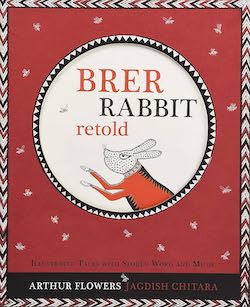
In the late 1800s, Joel Chandler Harris collected stories told by slaves in the southern United States, which he later published. In his version, the stories are told to a little white boy by Uncle Remus, a genial, happy slave, who recounts the adventures of Brer Rabbit, Brer Fox and other animals. Although he appreciated these stories which might not have survived if he had not written them down, Harris depicted “a slavery that had contented both master and slave”.
Arthur Flowers, a poet and writer from Memphis, Tennessee, has taken back these stories and retold them as “wisdom tales”, using a style that fuses the written word and African storytelling. The Brer Rabbit stories are, as he puts it, “one of the tap roots of African-American literature and culture”. This beautifully produced book is the result.
Brer Rabbit is a trickster who survives by his wits rather than by his physical strength. The character can be traced back to storytelling traditions in western, central and southern Africa. Some scholars believe that Brer Rabbit represents the slaves getting their own back on the slave owners.[1]
This is a selection of the Brer Rabbit stories as well as some new ones written by Flowers. They are a delight. Brer Rabbit runs circles around the bigger animals but is also outwitted in his turn.
The story about the race between the tortoise and the hare is retold here as “Brer Rabbit and Sistah Turtle”. Sistah Turtle does win the race but not in the way that the story is usually told. That is Brer Rabbit’s version: “Now, when Brer Rabbit recount this tale, he will likely tell you that he took a nap or some such, and that’s why Sistah Turtle beat him. To this day, it perplex him how he could get beat by a Turtle.”
There are references to slavery in “Brer Rabbit and the People Who Could Fly”, where abused slaves float up to the sky, far out of reach of the overseer’s whip. In “Sistah Rabbit and the Big Wind”, Brer Tiger lays claim to The Clayton Field, where The Tree of Life grows, a tree “burdened with the most succulent fruit and vegetables”, a tree that the other animals are not allowed near, even when there is a long drought and they are starving. The Tiger could be a representation of the slave owners who deny their slaves the abundant food they have access to. Needless to say, in this story, Sistah Rabbit outwits Brer Tiger by using his selfishness to trap him.
The stories are accompanied by stunning illustrations—illustrations that I would be happy to frame. The artist Jagdish Chitara, from the Vaghari nomadic community in India, works in the Gujarati Mata-Ni-Pachedi style of textile painting. The illustrations are in bright red and black and white—stylized and eye-catching. The book was printed and bound by hand.

There is a final surprise at the end. Nestled snugly in a little paper envelope stuck to the inside back cover is a CD with seven stories narrated by Flowers, accompanied by three Indian musicians playing the tabla, flute and guitar—a fusion of the griot style of storytelling, blues and Indian music. The musicians are Sarathy Korwar on percussion, Gandhaar Amin on flute and Vinay Kaushal on guitar. (For those of you who do not possess a CD player, there is a download code.)
This is the kind of book that is worth owning (it even smells like the old books in my father’s library). After I finished reading it, I wanted to buy copies for my friends!
 Talking About Books
Pingback: The Best Books of 2023 – Talking About Books