
Translated from French by Rachael McGill
Published by Dedalus Africa, 2021, 128 pages. Original version published in 2015.
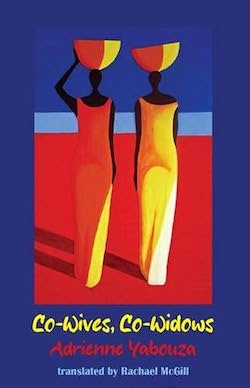
Lidou has a good life. He is married to two beautiful women, Ndongo Passy and Grekpoubou. His construction business is doing well: “he was throwing up building after building in the [Central African] Republic, and he’d carry on for as long as the Congolese and Cameroonian cement lasted”.
But death comes to him as he sits on his own, listening to Radio Ndéké Luka. He has a massive heart attack, and his children find him dead. His two wives are now widows.
As soon as news of Lidou’s death gets out, his cousin Zouaboua decides to take advantage of the situation. He rushes to the house and accuses the widows of poisoning Lidou. He locks all the rooms of the house and takes Lidou’s body to a doctor, ostensibly for a post-mortem. Zouaboua is familiar with the way things work: “He’d worked for so many years facilitating the lies of the powerful that he knew exactly who to speak to in any public or private service.” He bribes the doctor to certify death by poisoning.
Armed with this certificate, he is ready to take over Lidou’s business, money and all his worldly goods. But Ndongo Passy is not going to stand by and allow this man to bully her family and take away what is rightfully theirs. She and Grekpoubou take matters into their own hands and fight back.
Through the story of these two women, Adrienne Yabouza writes about life in the Central African Republic. The book begins with the two women getting dressed up to go and cast their vote. The picture Yabouza paints of the voting queue makes you feel the heat of the sun and the determination of those queueing to vote. The two men from the European Union who are supervising the electoral process tell each other that the election is “basically acceptable”. Lidou is unsure about whether he would vote. “I’m constructing this country, brick by brick, using nothing but my own graft”, he muses. “I should be voting for myself.”
What I loved most about Co-Wives, Co-Widows is Ndongo Passy. It’s always a pleasure to come across a feisty woman who refuses to be cowed by so-called important men. She is proud and generous. When Zouaboua gets the upper hand (for a while), she says “It’s OK. My life’s been tied in a knot that I can’t undo with my fingers, but I’ll use my teeth.” That’s the sort of woman I would love to know.
I got completely involved with the lives of the two widows, and was rooting for them. Yabouza writes with empathy for the women as well as a lot of humour: Ndongo Passy thinks of Zouaboua as “a man with fingers as sticky as a tree frog’s”. I enjoyed this book, which provided a rare glimpse into life in the CAR. This is the first book from the country to be translated into English.
 Talking About Books
Pingback: The Best Books of 2023 – Talking About Books
Pingback: Building Bridges through Stories – Talking About Books