
Published by Random House and Sceptre, 2007, 432 pages.
“I am leaving soon for the Nightland, where all ghosts of men and animals yearn to travel. … It is the last unmapped country, and a dark way getting there. A sorrowful path. And maybe not exactly Paradise at the end. The belief I’ve acquired over a generous and nevertheless inadequate time on earth is that we arrive in the afterlife as broken as when we departed from the world. But, on the other hand, I’ve always enjoyed a journey.”
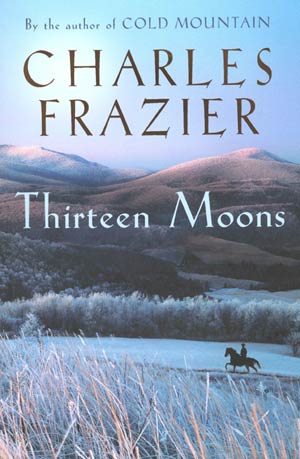
And so begins Charles Frazier’s Thirteen Moons about Will Cooper, a white man who became part of a Cherokee tribe. Set in the mid-nineteenth century, when Cherokee land and livelihoods were threatened by the American state, the book is based loosely on the life of William Holden Thomas, a Confederate army officer and the only white man to be the Principal Chief of the Eastern Band of Cherokee Indians.
The story is narrated by Will as an old man, looking back on his life. He loses his parents as a young child and is taken in by his aunt and uncle, who seem more interested in his inheritance. At age 12, Will is sold off, and sent to man a trading post at the edge of the Cherokee Nation, armed with nothing but a map, a horse, a key and some food.
Will does well at the trading post and learns to speak Cherokee. The local tribal chief, Bear, takes him under his wing and becomes like a father to him. Will also forges a strong connection with another Cherokee, Featherstone, who becomes “the father you want to kill. Or who wants to kill you.” He falls in love with a young woman, Claire, who he assumes is Featherstone’s daughter.
Then comes the Cherokee Removal, with the US government appropriating most of the Cherokee land and displacing its population. The Cherokees react to this in different ways: some fight, some give up, and others—like Featherstone—try and assimilate. Bear and Will work to protect the tribe by buying up as much of the land as they can, having concluded that the only thing that can stop the government from taking over Cherokee tribal land is the possession of the actual title deeds. Will becomes the tribe’s spokesperson and makes frequent trips to Washington to argue the tribe’s case. Frazier uses this to provide an insight into the politics and horse trading that went on during this time.
Will’s love for Claire and for the Cherokee tribe—and Bear in particular—become the driving forces of his life. Throughout the narrative, both before and after the Cherokees’ forced relocation, the book brings to life a neglected part of US and Native American history. All the characters in this book—including some of its minor ones—are extremely well-drawn.
What really strikes me about this book is its beautiful writing, always quietly thoughtful and lyrical. There is a stillness and depth that pulls you in from the start.
This is a novel that stays with you, and I know I’ll return to it again and again.
 Talking About Books
Pleased to come across this thoughtful review of Thirteen Moons. It’s a book I’ve come to re-read and re-listen – Will Patton’s audio presentation of Frazier’s prose is the one I recommend first to friends who are curious or reluctant to try audio.
I am still captivated by the deep sense of place, can visualize the broader landscape and the minute details down to the sound of falling snow, the fading scent of Claire’s lavendar in Will’s over-large coat, the dense, smoky, incense-filled air in the winter townhouse.
I’m currently on my third “listen” and continue to find new meaning, new interpretations as my life has changed and I’ve matured. This is a book worthy of owning two copies – one to dog-ear and underline, and one for lending.
Thank you for sharing that. Will look out for the audio book. I love the way you describe the details—the book is so vividly written.